ERP optimization is the process of improving your existing system’s performance — through business process changes, vendor configuration, automation, or business intelligence — without replacing it. In most cases, it is faster, cheaper, and lower risk than selecting and implementing a new system.
What happens when your ERP system is causing you grief?
What do you do about:
- All the excel spreadsheets you have in place to compensate for system deficiencies,
- Not getting the reports you need,
- Constant complaints from the users,
- Poor performance, and
- Multiple versions of the truth?
You don’t want to replace your ERP system unless you have no choice or there are so many problems that there is a compelling business case. You can ask your ERP vendor or implementer to help you with ERP optimization to improve system efficiency, but their focus is likely going to be with the tools they have – “If the only tool you have is a hammer, you tend to see every problem as a nail.”
Because 180 Systems does not sell or implement any ERP product, our recommendations are not limited to any single vendor’s toolset — we evaluate every available option and recommend what’s right for your business.
Why ERP Optimization is Critical
Effective ERP optimization is not just about fixing problems; it’s about maximizing the value of your existing system. A well-optimized ERP system helps eliminate inefficiencies, improve performance, and enhance decision-making. Organizations that invest in optimization rather than premature replacement consistently avoid the significant costs — both financial and operational — of a new ERP implementation.
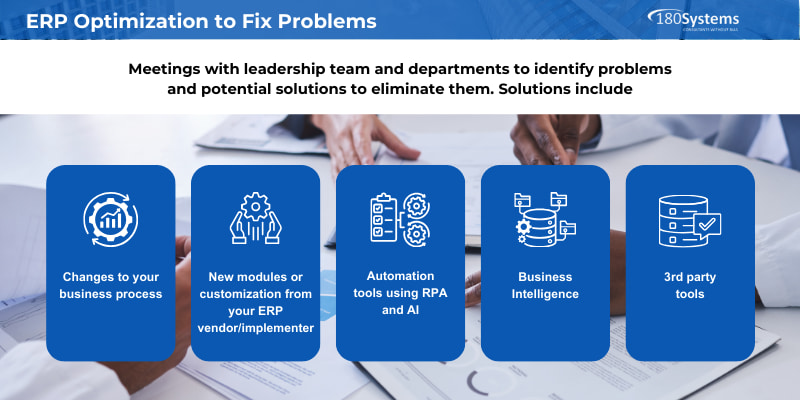
180 Systems will provide an independent analysis of your business process and will recommend multiple ERP optimization strategies, including:
- Changes to your business process
- New modules or customization from your ERP vendor/implementer
- Automation tools using RPA and AI
- Business Intelligence
- 3rd party tools
Through a well-executed ERP optimization strategy, you can streamline operations, reduce costs, and improve data accuracy — all without needing to replace your current system.
Start by Identifying the Problems
But before we get to solutions, you need to start with the problems that need to be addressed. You should start at the top and work your down the organization. First ask leadership to identify the major problems that need addressing and then drill down at the department level with the people in the trenches doing the work. The people closest to the work almost always identify problems that never surface in management reports — and those are often the highest-impact fixes.
There are good tools for automating this process including Poll Everywhere, which allows problems to be entered via a cell phone or laptop and upvoted by others. Quickly you will get a list of the biggest problems that need to be solved. Once problems are identified, it’s then time to consider the solutions. This is the foundation for a successful ERP optimization project.
Changes to your Business Process
You need to take a hard look at the business processes with problems and evaluate whether the work being done is providing good value to the organization. For example, why require managers to approve invoices when there is a matched PO and receiving report? Eliminating that approval step costs nothing — it’s a process change, not a system change, and it can save hours per week.
There may also be standard business processes that are automated in your ERP system, but which are different than what you have been doing for many years. It is better to adapt to the built-in/standard process unless the process is critical to your company. But how do you know it’s critical? An effective ERP optimization strategy involves aligning business processes with your Critical Success Factors (CSFs). CSFs are defined as the things you must do well in order to be successful strategically. If a process is not directly linked to a CSF, there is usually no good reason to defend it against a more efficient standard alternative.
New Modules or Customization from your ERP Vendor/Implementer
The ERP vendors/implementers are likely going to have solutions to many problems with new modules or customization, but what are the costs both now and in the future? In order to get a quote from the vendor, you should provide them with a specification so that you can get a fixed price. Customizations that are not based on standard development tools can also create upgrade risk — every time the vendor releases a new version, custom code may need to be rebuilt. Careful ERP optimization includes balancing customization needs with long-term maintenance costs.
Automation Tools using RPA and AI
RPA (Robotic Process Automation) can automate manual routine tasks based on defined rules such as matching invoices and generating emails to interested stakeholders. We have seen organizations deploy RPA for older systems that lack functionality that would be available in more modern systems. In many cases, RPA has extended the useful life of an ERP system by three to five years — at a fraction of the cost of replacement.
AI will take the automation further by simulating decision-making based on learning. The best example we have seen is in using OCR (Optical Character Recognition) to automatically create an invoice from an invoice received by email from a supplier. Vendors will have different formats and OCR will make mistakes in defining where the data is located. However, by manually correcting the location of the data once, AI will learn the next time where to find it. An advanced ERP optimization plan includes leveraging automation and AI to reduce manual effort and increase operational efficiency.
Business Intelligence
Business intelligence (BI) is defined as transforming data into information to make decisions. It comes in many forms including:
-
Analytical processing (like pivot tables)
-
Dashboards
-
Scorecards
-
Visualization (graphical representation)
-
Ad hoc queries
-
A report writer
-
Predictive modeling
There are many great BI systems available today and hopefully one of them is already integrated with your ERP system. But even if your system is not already integrated, it is worthwhile to get a BI tool to get you the information you need to make decisions. Microsoft Power BI and Tableau are two of the most commonly deployed BI tools in mid-market organizations, and both integrate well with most ERP platforms. A strong ERP optimization approach incorporates BI tools to improve decision-making and increase strategic insight.
3rd Party Tools
You can also compensate for missing functionality in your ERP systems by acquiring 3rd party tools that automate processes like A/P processing or workflow. Integration will be required, which is a cost, but the benefits could very well far exceed the costs. When evaluating 3rd party tools, prioritize vendors whose products are certified by or natively integrated with your ERP platform — this significantly reduces integration risk and ongoing maintenance overhead.
Many successful ERP optimization strategies involve integrating 3rd party solutions to fill gaps and improve system capabilities.
Frequently Asked Questions About ERP Optimization
What is ERP optimization?
ERP optimization is a structured process of improving how an existing ERP system performs — without replacing it. It includes reviewing business processes, identifying gaps, and applying targeted fixes such as configuration changes, automation tools, business intelligence, or vendor customization.
When should I optimize my ERP instead of replacing it?
Optimize when your system is still supported and capable of handling your volume, and the problems you’re experiencing stem from process, configuration, or adoption issues — not fundamental software limitations. Replacement is warranted only when there is a compelling, numbers-backed business case.
How does an independent ERP optimization assessment differ from asking my vendor?
Vendors are constrained by their own toolset. An independent consultant evaluates all available options — process changes, third-party tools, RPA, BI, and vendor customization — and recommends whatever combination delivers the best outcome for your business, regardless of who benefits commercially.
What are Critical Success Factors (CSFs) and why do they matter in ERP optimization?
CSFs are the things your organization must do well to be successful strategically. They matter in optimization because they determine which business processes should not be changed, even if they differ from an ERP’s built-in standard process. Aligning your optimization strategy to CSFs ensures you don’t compromise what actually drives your competitive advantage.
Can RPA and AI replace the need for a new ERP system?
In many cases, yes — particularly for organizations with older systems that lack modern automation capabilities. RPA and AI can automate tasks the ERP doesn’t natively handle, extending its useful life. Whether they’re the right answer depends on the specific gaps and the total cost of the automation versus replacement.
Start Your ERP Optimization Journey
If your ERP system is generating workarounds, complaints, and lost productivity, that’s a solvable problem in most cases — and the solution rarely requires a full replacement. The organizations that make the best decisions here are the ones that start with an independent assessment before committing to any path.
An ERP optimization plan from 180 Systems gives you an objective analysis of your business processes and a concrete set of solutions — business process changes, vendor fixes, automation, BI, or third-party tools — ranked by impact and cost. No vendor bias. No upsell agenda.
Learn more about our ERP Optimization Services or Book a Meeting to schedule a free consultation.
Related Articles: ERP Total Cost of Ownership · Top 10 ERP Implementation Mistakes · Business Process Review