Software Needs Assessment
Replacing your systems is not for the faint of heart. So, you better have a compelling business case before you start your journey. Our systems needs assessment will point the way forward, which could be to optimize, replace and/or integrate them.

The Problem
Many organizations have a myriad of different systems (ERP, MES, POS, SCM, custom…) that are not integrated and were selected and implemented by well-meaning departments within a company. Some of these systems may be great for a particular department, but not so great for the rest of the company.
As well, some of these systems are based on older technology and are on their last legs. What are you going to do?
We recommend a Needs Assessment
Our Needs Assessment Methodology
Step 1: Requirements Analysis
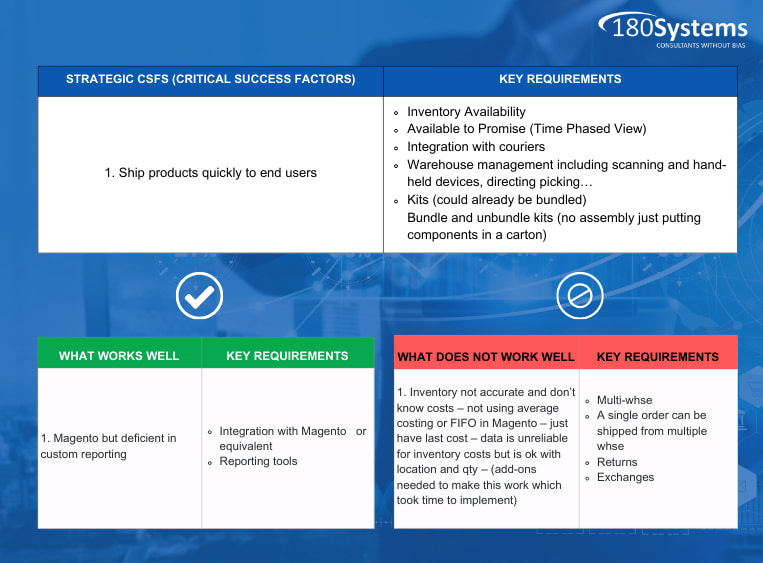
We meet with the executive group and ask them to identify Critical Success Factors (CSFs) and then discuss how a system could help achieve the CSFs. We also ask them to identify the biggest problems and then discuss how a system could eliminate them. Finally we ask them what they like about their existing systems, and these also become requirements. Here’s an example of mapping key requirements to CSFs, what works well and what does not work well.
We will then prepare one or more Requests for Information (RFI) to obtain high level costs and functional fit from vendors. The RFI is based on the requirements analysis plus our recommended requirements based on industry best practices. Lastly, we conduct a requirements review meeting to ensure the requirements are clear, unambiguous, accurate, complete and prioritized.
Step 2: Vendor Analysis
We will identify potential system solutions and issue the RFI(s) to the vendors. We will then prepare an analysis of the RFI results that include functional fit, estimated costs, underlying technology and similar clients.
Step 3: Business Case
One of the big problems with business cases is that they are written by the same people who want to be funded for a particular project. These people have a vested interest and typically find a way to make their case with numbers. It gets worse when organizations rely on vendors to help them with their business case. The vendors may have some slick material and may be able to offer a few ideas but they are clearly biased
Our methodology includes:
1. Estimate approximate Total Cost of Ownership (TCO) based on responses to an RFI
2. Estimate approximate benefits based on eliminating problems
3. Prepare a 5 year cash flow that includes a Return on Investment (ROI) calculation
Step 4: Systems Roadmap
This is where we point you in the right direction with:
1. System architectural diagrams for the current state and future state
2. A recommended plan of action
Frequently Asked Questions
What is a software needs assessment?
A software needs assessment is a structured review of a company’s systems, requirements and options that ends in a recommended plan. At 180 Systems it has four steps: requirements analysis, vendor analysis, a business case and a systems roadmap. The result can point toward optimizing, replacing or integrating systems, or a mix of the three.
When does a company need a software needs assessment?
A company needs one when it runs several systems that are not integrated, such as ERP, MES, POS, supply chain and custom applications, often chosen by individual departments. It also fits when some of those systems run on older technology and the company is unsure whether to fix, replace or connect them.
How is a needs assessment different from ERP software selection?
A needs assessment decides what to do, and ERP software selection decides which product to buy. The assessment compares options using RFIs, builds a business case and delivers a roadmap. ERP software selection then runs a full RFP, scripted demonstrations, reference checks and contract negotiation.
What does a software needs assessment deliver?
The deliverables are one or more RFIs, a prioritized requirements list, an analysis of vendor responses (functional fit, estimated cost, underlying technology and similar clients), a total cost of ownership and benefits estimate, a five year cash flow with ROI, current and future state architecture diagrams, and a recommended action plan.
Who builds the business case?
180 Systems prepares it independently. It estimates total cost of ownership from the RFI responses, estimates the benefits of removing specific problems, and calculates ROI over five years. Business cases written by project sponsors or vendors can be biased, which is why an independent view matters.
Who takes part in the assessment?
Executives take part first. They identify the critical success factors, the biggest problems and what already works well. The resulting requirements are then reviewed with the client for clarity, accuracy, completeness and priority before any vendor is approached.
Does a needs assessment always end with a new system?
No. The recommendation can be to keep and optimize the current ERP, integrate systems, replace one or more of them, or combine these options. The business case shows which path pays back.