M&A Technology Due Diligence

Why Does Every Integration Feel Like the First One?

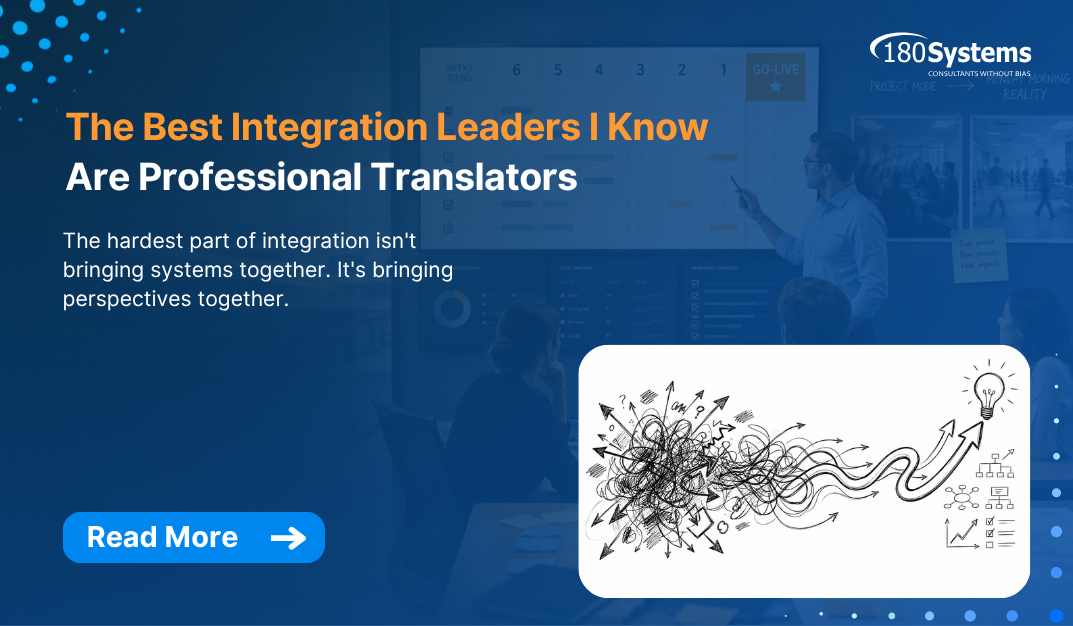
I’ve been living in two worlds lately. The first is research. Clean, structured, logical. It tells me exactly what organizations should be doing in integration. The second is operators. People who’ve done 30, 50, 150+ deals. Here’s the interesting part: They agree. Start integration early they say, align leadership, build the playbooks and don’t forget to capture lessons learned. Make sure to treat integration like a capability. So naturally, you’d expect consistent success, but no. Most integrations still underdeliver. Not dramatically, just quietly. Missed synergies, slow execution, talent walking out the door. So, what’s going on? We start too late… […]

Read More…

M&A integration failure_ Most Deals Don’t Fail. They Decay

Most Deals Don’t Fail. They Decay.

Everyone loves to quote the stat. Depending on the source, somewhere between 50% and 90% of acquisitions fail. It’s a wide range, which usually means we’re measuring different things, but the direction is consistent enough to be uncomfortable. Roughly half of acquisitions destroy value for the acquirer, and only about 30% to 50% fully deliver the synergies that justified the deal in the first place. None of this is new. We’ve known it for decades. What I find more interesting is not the statistic itself, but the fact that it hasn’t changed despite how much smarter we’ve become at everything […]

Read More…

M&A Technology Due Diligence_Pre-close Influence vs Post-close Accountability

Pre-close Influence vs Post-close Accountability

There’s a quiet structural flaw in how most M&A deals are done. It doesn’t show up in the model; it doesn’t sit in the risk register; and yet it’s one of the most reliable ways to lose value. The people who shape the deal are not the ones responsible for delivering it. By the time the operators arrive, the assumptions are already locked in, the commitments are already made, and the clock has already started. Take Cadbury. The narrative most people remember is emotional: a beloved brand, a hostile bidder, a defence mounted with conviction. The reality is far more […]

Read More…

When Technology Due Diligence Doesn’t Move the Needle (1)

When Tech Due Diligence Doesn’t Move the Needle

Most Technology Due Diligence reports are thorough. Painfully thorough. They catalogue systems, they map infrastructure, they inventory applications with the enthusiasm of someone counting grains of sand on a beach. And yet, after all that work, many of them do not actually change the deal decision. So, I ran a poll in the Forbes Leadership Think Tank community asking a simple question: Where does Tech Due Diligence most often fall short? Results were interesting… None of these surprised me, what surprised me was how evenly they reinforce the same underlying problem. Technology Due Diligence often answers the wrong question because […]

Read More…

AI in M&A (2)

AI in M&A: Useful Intern, Terrible Deal Lead

AI is having a moment in M&A advisory. Depending on who you ask, it is either quietly transforming how M&A advisory firms operate or about to replace half the diligence ecosystem. Both statements are wrong, but one sells better. The truth sits somewhere in the middle. AI is helpful in M&A. It is not decisive. And it certainly is not accountable. Right now, AI shows up best as an extremely fast, extremely literal intern inside the M&A advisory process. It reads everything. It flags patterns. It never gets tired. It also has absolutely no idea why something matters. That distinction […]

Read More…

How M&A Advisory Teams Carve Out a Business Without Tech Damage

The Break-Up Before V-Day: How M&A Advisory Teams Carve Out a Business Without Tech Damage

While some relationships are solidified over Valentine’s Day, others are meant to end. Some end quietly. Some end loudly. And some end with a carefully negotiated carve-out, multiple lawyers on speed dial, and a shared ERP that refuses to let go. For M&A Advisory firms, carve-outs are the corporate equivalent of a grown-up breakup. Everyone agrees it is for the best. Everyone promises to stay professional. And then technology gets involved and reminds both sides why this was complicated in the first place. From an M&A Advisory and execution standpoint, carve-outs are not about separation alone. They are about survival. […]

Read More…

The January Reality Check Technology and the First 100 Days After a Merger

The January Reality Check: Technology and the First 100 Days After a Merger

January has a way of sobering everyone up. The decorations come down, inboxes refill, and that ambitious end-of-year deal suddenly becomes very real. The contracts are signed, the announcements are out, and now someone has to make the merger actually work. This is where the first 100 days quietly decide whether the deal settles in nicely or becomes the thing everyone politely avoids talking about by March. Post-merger integration is often framed as a people and process exercise, but technology is the backbone holding the whole plan upright. You can have alignment workshops, leadership town halls, and beautifully worded vision […]

Read More…

Why Technology Due Diligence Matters Before a Merger (3)

The Holiday Surprise You Do Not Want: Why Technology Due Diligence Matters Before a Merger

Mergers often feel like the corporate version of the holidays. There is excitement, anticipation, big plans, and the optimistic belief that everything will come together beautifully. But just like the holidays, the part that looks magical on the outside usually hides a fair amount of scrambling behind the scenes. And while leaders gather around the deal table making lists and checking them twice, technology due diligence somehow gets treated like the last-minute gift someone remembers on the way to the party. A quick stop, a rushed decision, and a hope that everything works out. Spoiler alert: it usually does not. […]

Read More…

M&A Without the Migraine (1)

M&A Without the Migraine

Everyone loves a merger until someone opens the shared drive. Suddenly, the spreadsheets do not match, half the files are named “final_v7,” and the CFO is wondering why there are three versions of the customer database. The headlines make mergers and acquisitions sound glamorous, but anyone who has lived through one knows it is more caffeine than champagne. The part that rarely makes the press release is the operational reality. The systems, data, and processes that quietly keep businesses running do not always get along. Integration becomes the invisible risk that can turn an impressive deal into a slow-motion headache. […]

Read More…