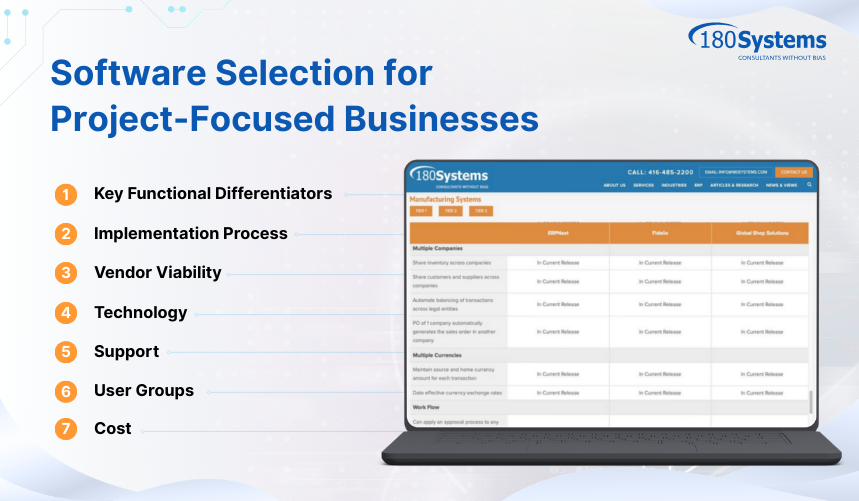
Software Selection for Project-Focused Businesses
Business software systems are similar when it comes to basic functionality, but you need to look under the hood for the functionality specific to project–focused businesses (PFBs).This white paper will discuss the major functional differentiators of a PFB system as well as other criteria to consider when making a vendor selection decision. This white paper was sponsored by Deltek.
Table of Contents in the white paper
- Key Functional Differentiators
- Implementation Process
- Vendor Viability
- Technology
- Support
- User Groups
- Cost
Click here to obtain the white paper.
Software Selection for Project-Focused Businesses
Business software systems are similar when it comes to basic functionality, but you need to look under the hood for the functionality specific to project–focused businesses (PFBs). This white paper will discuss the major functional differentiators of a PFB system as well as other criteria to consider when making a vendor selection decision. These additional factors include the implementation process, vendor viability, technology, product support, user groups, and costs.
Key Functional Differentiators
It is not possible to identify all key functional differentiators of a true PFB software system as there are too many, and they can vary by type of PFB and size of company. However, below are examples of some of the critical functionality required by a PFB:
1. Customer Relationship Management (CRM). Many PFBs require CRM tools that facilitate converting leads into clients as well as providing full visibility of all relationships that could potentially influence conversion rates. Another very important feature is the ability to integrate the CRM system to Microsoft Outlook, so contacts, meetings, and emails can be tracked and synched up between systems.
2. Estimating. Estimating includes not only the tools to generate the estimate but also to optionally include the data in forecasting and project planning.
3. Project management. Project managers should be able to indicate estimated time to complete and require real-time visibility on project status and profitability. Management should be able to analyze projects across multiple dimensions such as office, service line or manager. Staff should also be able to indicate when activities are complete which should trigger billing or other dependent activities.
4. Resource management. Resource management includes tracking skills, certifications, and availability by employee to facilitate allocation of resources to projects.
5. Project Scheduling. Scheduling should either provide similar functionality to software such as Microsoft Project or have tight two-way integration.
6. Timesheets. Timesheets need to be fast and easy so that they do not cause already busy staff to complain about the work to complete them. Timesheets should be web-enabled, capable of being entered offline and synchronized to the main system and support access and entry by mobile devices.
7. Expense reporting. Expense reporting should include rules such as maximums and automated transfer to projects, to billing when chargeable with optional markups and to payroll or accounts payable for employee reimbursement.
8. Billing. The system should support multiple methods including time and materials, fixed fee, percent complete and milestone billing. Other functionality includes a flexible employee rate table, the ability to present the bill in detail or in summary as well as being able to format it without resorting to an external program such Microsoft
Word.
9. Budgeting and Forecasting. Budgeting and forecasting for PFBs is based on the data in the HR and/or Resource Management system, and opportunities from CRM and existing projects. It also requires algorithms that are specific to PFBs such as anticipated employee utilization rates.
10. Business Intelligence. Business Intelligence is about transforming data into information useful to make decisions. The system should include a spectrum of tools including a report writer that does not require a programmer and role-based dashboards that show employees and management their critical information with the ability to drill down for details. Key Performance Indicators such as utilization and efficiency should be easily generated with out-of-the-box functionality.
11. WIP (Work in progress). Some organizations first update WIP for work done and later remove WIP when clients are billed. Basic functionality would include an aged WIP report. More advanced functionality would allow write-ups and write-downs by project.
12. Financials. The financial system should include project accounting, flexible revenue recognition models, and reporting by multiple dimensions such as office, service line or manager.
13. Workflow. Workflow will automate the approval process for timesheets and expenses as well as generate alerts when there are problems. Workflow should accommodate business rules that could for example trigger an alert if a milestone is late, and allow configuration without the need for a programmer to customize the actual
software code.
Before embarking on a vendor selection process, ensure functional requirements are unambiguous and very specific or it is possible that vendors will misinterpret them. The vendors should also be required to demonstrate the processes related to the functional requirements. Red flags should appear if the vendors say that their system needs a little tweaking to meet the basic key differentiators one would expect in a system for PFBs.
Implementation Process
There are not only differences in functionality but also in a company’s ability to implement the systems. Too often buying organizations spend most of their time evaluating the features in a system and not enough time evaluating the implementers of the software. There can be huge differences in capabilities and experience of the implementers. It is not sufficient for the implementers to know how the system works. They also should know how to align and optimize business processes with their software system and be aware of best practices for the PFB industry.
Vendor Viability
One would think that only the big vendors will survive in the long run, and that the safe bet is just to implement one of their systems. But the reality is that smaller vendors can be very profitable and not be in danger of going out of business. They have smaller overheads and don’t need as many new clients each year as the big vendors. There is the risk that the smaller vendors will be bought out but it is not likely that the acquirer will abandon the acquired product if it is well established and uses recent technology. The trend by most of the vendors that have already purchased
other vendors is to continue to invest in the products purchased – or risk the wrath of their new clients.
Technology
The underlying technology should be based on one of the leading software development tools and one of the leading databases. It should also provide three-tier architecture such that the user interface, business logic and database are all separated thereby maximizing performance. It is also highly desirable that the system be based on one unified database rather than multiple databases that need to be integrated. Integration also offers the advantage of real-time results throughout the system. The technology should allow end users to customize the system outside of source code so that future upgrades do not cause the customizations to break.
Support
Vendors differ in their ability to provide timely and professional support services especially if support is required for a global PFB. Not all vendors offer 24X7 with guaranteed response times. Not all vendors have dedicated support staff with knowledge-based tools and automated escalation should critical problems not be resolved on a timely basis. Not all support staff are trained to understand the specific functionality important to PFBs.
User Groups
Vendors typically offer annual user group conferences to demonstrate the latest enhancements, share best practices and allow attendees to network. Ideally the user groups should offer an opportunity to exchange ideas and discuss issues that are impacting today’s PFBs.
Costs
The total costs of ownership should be considered in selecting a new system, which consist of license fees or annual subscription fees for SaaS (Software as a Service) solutions, implementation fees, infrastructure changes, maintenance fees and internal costs. Implementation fees as a ratio of license costs range from 1:1 to 3:1 depending on the complexity of the systems and the implementation methodology. Internal costs also vary based on complexity and implementation methodology and can be the highest cost of all. Vendors annually charge from 16-22% of the before discounted or list price of the software for maintenance fees. Some vendors charge additional fees for support. Organizations should prepare a discounted cash flow to properly compare the true costs of a new system.
Summary
PSA (Professional Services Automation) was a good acronym for a system designed for PFBs. Gradually PSA has been subsumed by the ERP (Enterprise Resource Planning) acronym as more capabilities were added to the enterprise system and the scope of the software expanded. Now, there are business software systems in the market that cover the entire service delivery lifecycle, and unify all critical business processes within a PFB.
It was not that long ago when organizations purchased ERP software with an expected life of 5-10 years. Today, the objective is to select ERP for life. So when selecting a new system, ensure the vendor clearly demonstrates their longterm commitment to the product as evidenced by their R&D track record, their planned enhancements, and their marketing campaigns.
My advice is to open the hood on the short-listed products and not to assume that key functionality is readily available. Vendors should be asked to follow a script in their demonstration that would reflect day-in-the-life scenarios of a PFB. The script should also include the problems with the existing system. Each problem should be considered an opportunity with a new system. The vendor should provide suggestions to improve business process based on their PFB experience and have the right tools and people to do it. Last but not least, talk to their customers who are similar to you in size and industry.
They say that life is a journey, not a destination. When it comes to software selection, the journey has only just started.
Why Work with Independent ERP Consultants?
At 180 Systems, we are independent ERP selection consultants and do not sell or implement any product or accept any compensation from vendors or implementers for our advice or services. Our only goal is to help you choose the right system and optimize your ERP investment.
Contact 180 Systems to learn more about:
-
ERP budgeting and cost analysis
-
ERP selection strategy
-
ERP project advisory and RFP support