An ERP software selection methodology is the structured process a company follows to evaluate, compare, and choose the right ERP system — from defining requirements through contract negotiation. Done correctly, it reduces implementation risk, controls costs, and ensures the selected system actually fits how your business operates.
This is a ERP software selection process that you are probably dreading, but it’s also an opportunity to improve business process and get your team energized on a new system. The following is a brief description of our methodology. If you’re looking for a step-by-step ERP software selection methodology backed by years of consulting experience, you’ve come to the right place.
1. Requirements Analysis
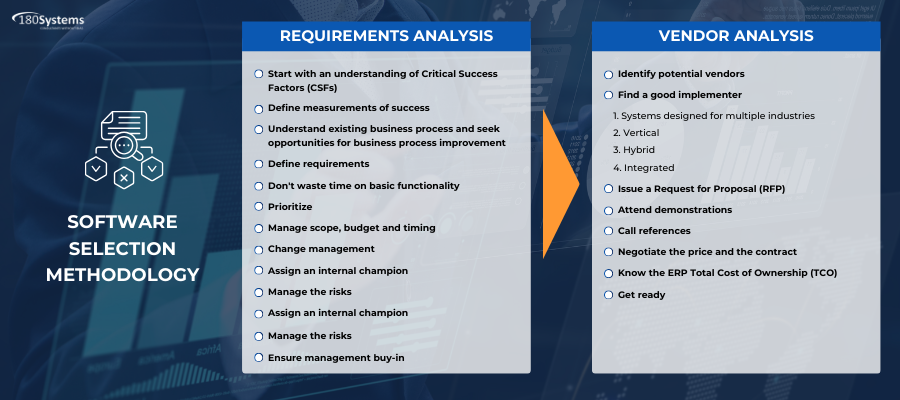
Start with an understanding of Critical Success Factors (CSFs)
CSFs are defined as those things that you must do well in order to be successful. You can use CSFs as a way to start defining requirements from the management group. Anchoring your ERP requirements in CSFs ensures the system you select supports your actual competitive priorities — not just a generic checklist of features. These best practices in ERP requirements analysis are core to successful ERP software selection projects.
Define measurements of success
Before starting any project, you should know how to measure success in terms of saving money by streamlining operations, increasing revenues, increasing market share, and improving inventory management. These success metrics are not just reporting KPIs—they motivate staff during ERP implementation and keep projects aligned with business objectives. Make sure your ERP requirements link back to CSFs and measurable outcomes.
Understand existing business process and seek opportunities for business process improvement
Until you have understood the existing business process, you are not ready. Employees may not know that what they are doing is atypical. Roll up your sleeves and talk to the people who do the work. Remember the devil is in the details. Along the way, your value add is in identifying ways to improve business process. Every problem is an opportunity in a new system. In our experience, organizations that skip this step end up selecting a system that automates their existing inefficiencies rather than eliminating them.
Define requirements
Defining requirements is the most important factor in a successful selection of a new system. Requirements should be unambiguous, clear, accurate and complete. The more ambiguous the requirement, the more interpretation in whether a particular vendor meets the requirement. Vague requirements also give vendors room to overstate their fit — which surfaces as painful surprises after contract signing.
Don’t waste time on basic functionality
ERP softwares have matured to the point where the basics are done well. Focus only on the requirements that are unique or could vary by vendor. If a requirement is something every modern ERP handles — standard GL, basic inventory, sales order processing — strike it from the critical list and spend your evaluation time on the requirements that actually differentiate vendors.
Prioritize
Not all requirements are created equally. Use a numbering system such as “5” = critical, “4” = very high, “3” = high, “2” = medium, “1” = low. If you have mostly “5”s, there is something wrong. We target 20% to be critical. This discipline forces honest conversations about what the business actually needs versus what individual stakeholders want — and it is one of the most valuable things an independent consultant brings to the process.
Manage scope, budget and timing
Project management is also a key factor in predicting success of any ERP software selection project. Project management includes management of scope, budget and timing. It starts with software selection, but the rubber hits the road during the implementation.
Change management
Recognize the significant amount of employee knowledge and seek out their input. At the same time, you are effectively including them in the process and mitigating resistance to change. Just like project management, change management starts in the software selection project but becomes critical in the ERP implementation process. The organizations that struggle most with change management are the ones that treated selection as an IT project rather than a business transformation.
Assign an internal champion
An internal champion should be allocated to the project. Even the most difficult projects can become successful when you have an internal champion who is ready to do whatever it takes to get the job done. It is best to assign the internal champion at the beginning of the software selection project to ensure their commitment and agreement with the system selected.
Manage the risks
Seek out potential risks, their impact, and their likelihood of occurring. Encourage all interested parties to develop strategies to mitigate the risks. Every organization has at least 1 naysayer, who can cause a lot of problems, but who is also very knowledgeable. The naysayers must be included in the risk management process. By getting their input early, you can avoid problems, and you effectively limit their negativity.
Ensure management buy-in
Communicate scope of project and get sign off at critical steps along the way. Management should develop or ratify the measurements of success. Without active management buy-in, even a technically well-executed ERP software selection can unravel during implementation when priorities shift and resources get pulled.
2. Vendor Analysis
Identify potential vendors
You would be amazed at how many vendors want your business and there are many different kinds of systems for you to consider:
- Systems designed for multiple industries – These systems have more customers and more resellers, which means more access to support. These systems usually shine when it comes to financials and user interface but can be complex to implement because of all the industries they support.
- Vertical – These systems have functionality designed for a specific industry.
- Hybrid – Some vendors offer their technology and marketing to business partners who extend the primary system for specific industries.
- Integrated – You may not find a vendor that has it all and you require multiple systems that should be integrated. Integration can be challenging not just at the beginning but also as both systems evolve, and the integration has to adapt.
To obtain lists of potential vendors for ERP software selection proceess:
- use our ERP comparison
- use internet searches
- contact colleagues
- contact ERP selection consultants
- contact industry associations
- look at trade journals for articles and advertisements
- check out software vendors at trade shows
- try to find what systems are used by similar companies or competitors
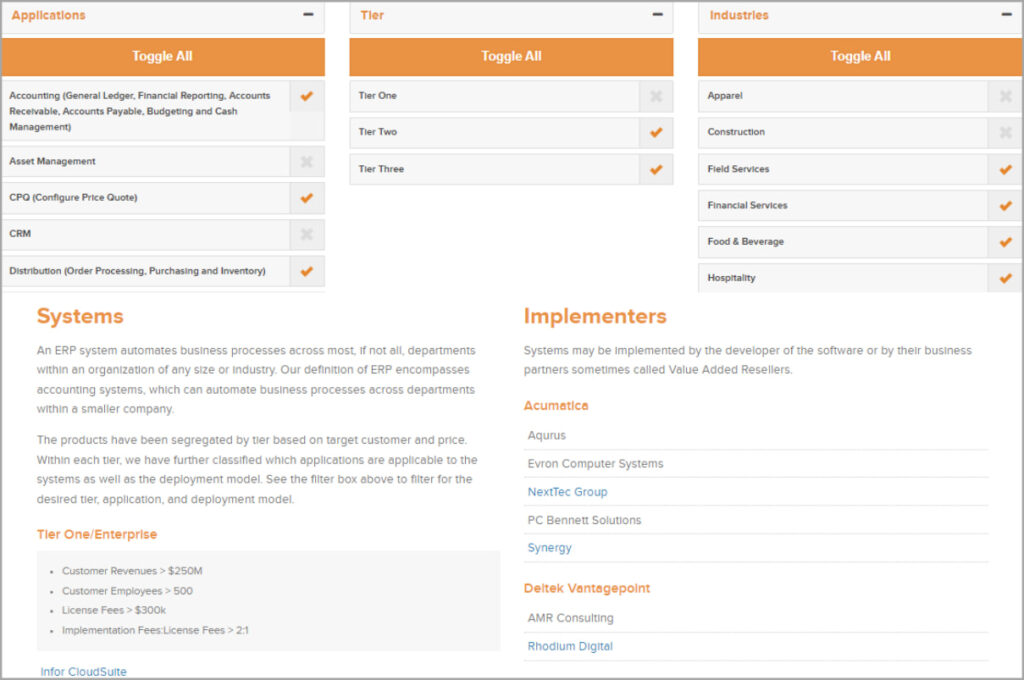
Vendor analysis is one of the most underestimated steps in the ERP software selection process. Choosing the right software is important—but selecting the right implementation partner is critical.
Find a good implementer
The implementer of the system (sometimes called Value-Added Reseller or VAR) can make a big difference to the success of the ERP implementation (as noted by NetSuite). Often, companies selecting new ERP software spend a lot of time analyzing the product and the vendor but not enough time analyzing the experience and capabilities of the implementer. The most important ERP selection criteria should be experience in your industry. The reason this is so important is that the ERP implementer will be guiding you in the design of your business processes. It would be very helpful if they have already designed something similar and you can leverage work already done for other companies rather than start from scratch. Ask every implementer candidate for references from companies in your specific industry — not just their general client list.
Issue a Request for Proposal (RFP)
An Request for Proposal RFP is a great tool to communicate your needs uniformly to vendors and to create a short list of vendors. Ask ERP vendors to answer questions related to cost, technology, customer base, developer and implementer qualifications, and similar customers. Have the ERP vendors respond to each requirement with a number such as:
- 9 = Requirement is fully addressed in the standard system
- 8 = Configuration change
- 6 = 3rd party using same tools and database as primary system
- 5 = Workaround
- 4 = Minor customization
- 3 = 3rd party using different tools than primary system
- 2 = Plans to fully address in the next year
- 1 = Major customization
- 0 = Not available
By extending the priority of each requirement times the vendor response, and then summing the results, you get a score that will give you an indication of closeness of fit for each vendor in ERP software selection criteria. A vendor who scores heavily on “5” (workarounds) and “4” (minor customizations) is signaling that your requirements don’t fit their system well — regardless of how confidently they presented in the demo.
Attend demonstrations
It is critical to provide the vendors with a script for the demonstration. If not, they will show you what they do best and not necessarily what you need the most. You will also not be able to compare the different systems. We recommend 2 demonstrations.
- The 1st one should be based on your most critical ERP requirements and the 2nd one should be based on business process.
- The 2nd one will likely take at least one day and should show you what is called the “To-Be Business Process” and what you should expect for some of your business processes. It is impossible for the demonstration to include all of your requirements or business processes, so pick the most challenging and critical ones
If a vendor resists following your script or insists on showing their “standard demo” instead, treat that as a red flag — a good implementer should be able to demonstrate exactly what you need.
Call references
You will be amazed at how much you learn and how little some of the vendors know their customers. Tell the reference a little about yourself before asking any questions so that they have a level of comfort with you and regard you as a colleague. Ask specifically about what went wrong and how the vendor responded — that tells you far more than what went right.
Click here for more about reference checking and downloading a reference check template that is the same as the following
| Question | Reponse |
|---|---|
| Vendor | |
| Reference Company | |
| Call Date | |
| Reference Contact / Title | |
| Telephone | |
| Reference Company Background – Industry and Size | |
| What implemented including main modules | |
| When | |
| # of users | |
| What vendors considered in selection process | |
| Why software chosen | |
| Implementation | |
| • Who did it | |
| • How long did implementation take | |
| • Extent of integration required | |
| • Extent of customization required | |
| • Any problems | |
| • Impact on staff | |
| • On-going effort to support system | |
| • IT involvement | |
| • Rate implementer out of 10 | |
| Score out of 10 (ask for explanation for any low scores) | |
| • Ease of use | |
| • Flexibility | |
| • Reliability | |
| • Performance | |
| • Security | |
| • Reporting including dashboards, analytics and ad-hoc reporting | |
| • Customization | |
| • Module such as General Ledger and Financial reporting | |
| • Module ??? (where ??? = the modules that are being selected) | |
| • Support | |
| • Upgrade process | |
| Do it again | |
| Things to avoid or other recommendations | |
| Conclusion of interviewer based on the above questions and answers |
Negotiate the price and the contract
Many of the ERP vendors offer competitive pricing when they know they could lose to a competitor who could offer a reasonable solution at lower a price. Also read the fine print especially when it comes to escalation of the cost of the software after the initial term and the cost of new licences. Maintenance fee escalation clauses — often buried in multi-year contracts — can increase your annual costs by 15–20% within three years. Always negotiate a cap. For a deeper look at contract negotiation, see our ERP Contract Negotiation guide.
Know the ERP Total Cost of Ownership (TCO) in ERP Software Selection
You need to understand all the costs including license fees, implementation, support, hardware, networks and communications before making a decision during ERP software selection process. There should be no surprises later. TCO over five years is frequently two to three times the initial license cost — organizations that budget only for the software itself are almost always underfunded by go-live.
Click here for more about TCO.
Get ready
- Finalize project objectives, CSFs, and KPIs
- Define the core team’s roles & responsibilities and assign people to each role
- Build the preliminary ERP project plan & governance package
- Take a deep breath and prepare yourself for challenges. There inevitably will be challenges and what is important is finding a way to resolve them.
Martin Luther King Jr. said “The ultimate measure of a man is not where he stands in moments of comfort and convenience, but where he stands at times of challenge and controversy.” You can measure the vendor and your team in the way they respond to implementation challenges. Hopefully they are up to the challenge, or you should consider finding people who are ready for the inevitable.
Frequently Asked Questions About ERP Software Selection
What is an ERP software selection methodology?
An ERP software selection methodology is the structured process a company follows to evaluate and choose the right ERP system. It covers requirements analysis, vendor identification, RFP issuance, demonstrations, reference checks, contract negotiation, and implementation readiness. A structured methodology significantly reduces the risk of selecting the wrong system or the wrong implementer.
How long does an ERP software selection process take?
A thorough ERP selection process typically takes three to six months — most of that time is spent waiting for vendor RFP responses and scheduling demonstrations. Rushing the process to hit an arbitrary deadline is one of the most common causes of poor system fit.
What is the most important factor in ERP software selection?
Requirements definition is the single most important factor. Without clear, prioritized, unambiguous requirements, vendors cannot accurately assess fit, demonstrations become impossible to compare, and the risk of selecting a mismatched system rises sharply. Most failed ERP selections trace back to a requirements process that was rushed or skipped entirely.
Should I use an independent ERP consultant or rely on the vendor?
An independent ERP consultant has no financial stake in which system you choose — their job is to protect your interests. Vendors and implementers are motivated to win the deal. For a decision of this magnitude, independent guidance during requirements analysis, RFP scoring, and contract negotiation consistently produces better outcomes and lower total cost of ownership.
What is the difference between an ERP vendor and an ERP implementer?
The vendor develops and maintains the ERP software. The implementer (often called a VAR or Value-Added Reseller) installs, configures, and customizes it for your business. They are often separate organizations, and experience in your specific industry is the most important selection criterion for the implementer — not just the software itself.
How do I know which ERP system is the right fit for my industry?
Start with a requirements analysis grounded in your Critical Success Factors, then evaluate vendors using a scored RFP against those requirements. Industry-specific functionality, the implementer’s track record in your sector, and reference checks from companies similar to yours are the most reliable signals of fit.
Related reading: Top 10 ERP Software Selection Mistakes · ERP Total Cost of Ownership · ERP Contract Negotiation · Business Process Review
Why Trust 180 Systems as Your ERP Software Selection Partner?
At 180 Systems, we specialize in vendor-neutral ERP consulting. Our methodology is grounded in decades of hands-on experience helping mid-sized and large enterprises across North America. From ERP software selection to ERP project management, our independent ERP consultants deliver structured, transparent, and expert-driven guidance throughout the ERP lifecycle. We do not sell, implement, or accept compensation from any ERP vendor — which means our only interest is selecting the system that is right for your business.
Ready to get started? Book a Meeting for a no-obligation consultation on ERP system selection.