Everyone loves to quote the stat. Depending on the source, somewhere between 50% and 90% of acquisitions fail. It’s a wide range, which usually means we’re measuring different things, but the direction is consistent enough to be uncomfortable. Roughly half of acquisitions destroy value for the acquirer, and only about 30% to 50% fully deliver the synergies that justified the deal in the first place. None of this is new. We’ve known it for decades.
What I find more interesting is not the statistic itself, but the fact that it hasn’t changed despite how much smarter we’ve become at everything leading up to the deal. We have better data, better models, better advisors, and far more structured diligence processes than we did even ten years ago. On paper, we should be getting better outcomes. In practice, we’re not. At least not consistently.
The academic perspective is easy to absorb. It’s clean, logical, and supported by frameworks that lay out exactly what organizations should be doing during integration. But when you shift to operators; people who have actually led dozens of integrations across private equity and corporate environments, the picture changes. What’s interesting is that they don’t disagree. They’ll tell you the same things the literature does. Start integration early. Align leadership. Be clear on the value thesis. Protect your people. Build repeatable playbooks. None of this is controversial.
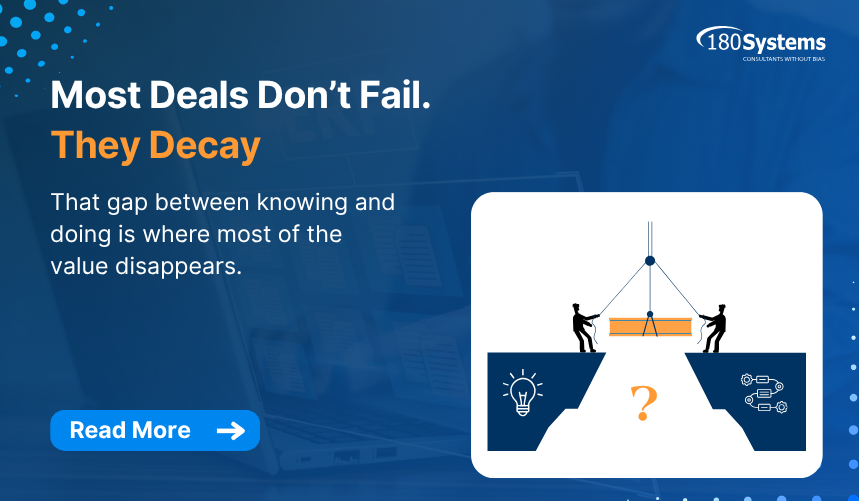
And yet, when you look at how deals actually unfold, integration still tends to start too late, decisions get made without full alignment, and execution becomes reactive instead of deliberate. That gap between knowing and doing is where most of the value disappears.
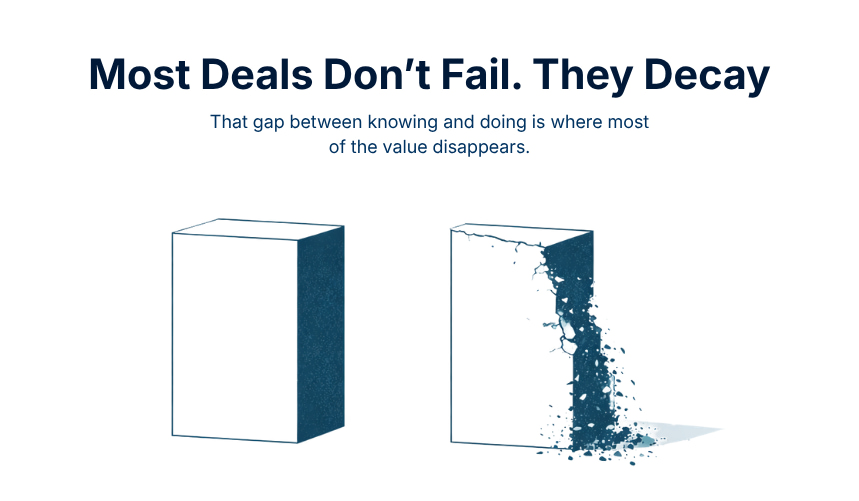
The failure itself is rarely dramatic. Most deals don’t blow up. They erode. Synergies arrive slower than expected or quietly get redefined. Systems don’t fully integrate, so teams keep working in parallel. Key people leave, but not all at once, just enough to create friction. On paper, the deal closes successfully and the organization moves on. In reality, a portion of the value just never shows up. It’s not a headline failure, but it’s still a miss.
What I’ve come to believe is that we’re framing the problem incorrectly. We tend to treat integration as a phase in the deal lifecycle; something that happens after signing and stabilizes once the org chart is in place. But integration isn’t a phase. It’s a capability. And most organizations haven’t built it.
We invest heavily in deal capability. Corporate development teams are well structured, diligence processes are refined, and financial models are stress-tested from every angle. Integration, on the other hand, often gets staffed with whoever is available, led by someone doing it for the first time, and planned under tight timelines once the deal is already in motion. Then we expect consistent outcomes.
The organizations that perform differently tend to approach this in a fundamentally different way. They don’t treat integration as a one-off project tied to a specific transaction. They treat it as a system that improves over time. They have dedicated integration leadership, consistent governance structures, and a way of actually capturing and reusing what they learn from each deal. More importantly, they start thinking about integration before the deal is signed, not after.
For everyone else, each acquisition is treated as a new event. New team, new plan, new set of assumptions. Whatever was learned last time rarely makes it into the next one in a structured way. Over time, that creates a kind of compounding drag. Decisions get repeated, mistakes get recycled, and execution never quite becomes predictable.
So when people ask why so many deals fail, I’m not convinced that’s the most useful question anymore. A better one might be this: why do we continue to execute acquisitions without building the internal capability required to integrate them properly?
Because until that changes, the outcomes probably won’t either. And we’ll keep reacting to results that, if we’re being honest, were entirely predictable from the start.