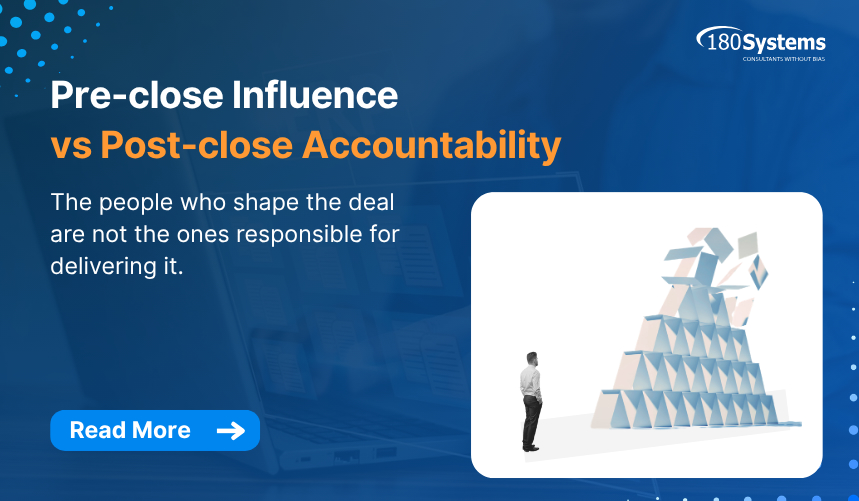
There’s a quiet structural flaw in how most M&A deals are done. It doesn’t show up in the model; it doesn’t sit in the risk register; and yet it’s one of the most reliable ways to lose value. The people who shape the deal are not the ones responsible for delivering it. By the time the operators arrive, the assumptions are already locked in, the commitments are already made, and the clock has already started.
Take Cadbury. The narrative most people remember is emotional: a beloved brand, a hostile bidder, a defence mounted with conviction. The reality is far more mechanical. The board’s job was not to “save” the company; it was to extract maximum value for shareholders. As the process unfolded, the shareholder base shifted, long-term holders exited, arbitrage funds moved in, and the time horizon compressed. At that point, the outcome wasn’t driven by strategy or culture; it was driven by price. When the offer hit the tipping point, the decision was effectively made. Someone still had to integrate the business afterward; they just weren’t the ones who shaped the conditions under which that integration would happen.

Now look at Coopers Brewery. Different situation, same underlying pattern. A fiercely independent, family-controlled business, deeply tied to identity and culture, facing pressure from a much larger player. The story reads like a classic defence of values over economics. But what actually held the line wasn’t culture alone; it was governance. Share structures, pre-emptive rights, buyback mechanisms, all of it engineered over time to control who could influence outcomes and when. The operators didn’t “win” that battle in the moment; the structure had already been designed to make that outcome possible.

This is the part that rarely gets said out loud. Deals are shaped in rooms where execution is not the primary constraint. Assumptions about synergies, timelines, and integration complexity are set before the people responsible for delivering them are fully in the conversation. Then, post-close, those same people are held accountable for hitting targets they had no hand in defining. It’s not that anyone did poor work; it’s that the system separates influence from accountability.
You see the consequences everywhere. Synergies that look clean in a model become messy in reality. Timelines slip, not because teams are slow, but because dependencies were underestimated. Technology integration becomes the long pole, even though it was treated as a workstream detail during diligence. None of this is surprising when you look at how decisions are made. Value leakage doesn’t start on Day 1; it’s baked in long before close.
It’s easy to say, “bring integration in earlier,” and to be fair, that’s directionally right. But that advice is often too shallow. The real issue isn’t timing; it’s influence. If integration leaders are present but not shaping assumptions, nothing changes. If technology findings don’t alter deal structure, they’re just documentation. If operators are consulted but not listened to, the outcome is already decided. Presence without influence is theatre.
The uncomfortable truth is that this separation exists for a reason. Deals move fast. Certainty is valued. Negotiations reward clarity, not nuance. Introducing operational complexity into that environment can feel like friction. But that friction is where reality lives. Remove it too early, and it shows up later with interest.
So, the question isn’t whether integration should be involved earlier. It’s whether the people accountable for outcomes are actually shaping the decisions that define those outcomes. Because if they’re not, you’re not managing integration risk; you’re just transferring it.
Where have you seen this play out most clearly in your experience, and what, if anything, actually shifted influence upstream?