Most Technology Due Diligence reports are thorough. Painfully thorough.
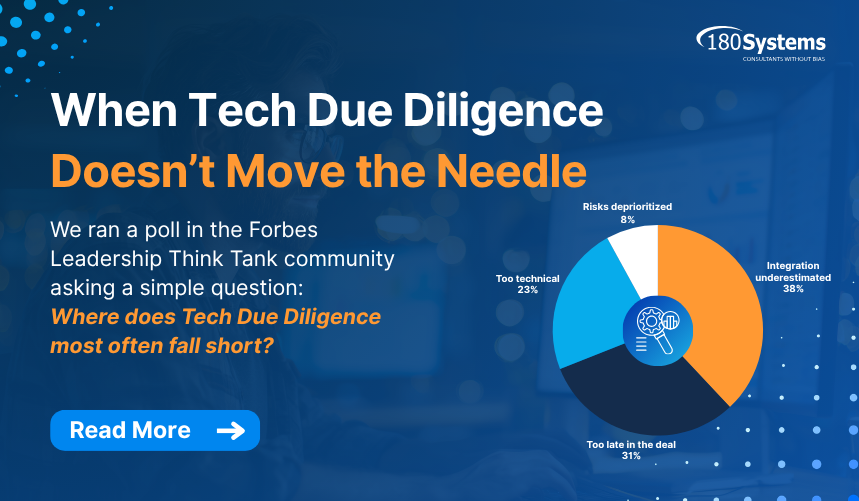
They catalogue systems, they map infrastructure, they inventory applications with the enthusiasm of someone counting grains of sand on a beach. And yet, after all that work, many of them do not actually change the deal decision. So, I ran a poll in the Forbes Leadership Think Tank community asking a simple question: Where does Tech Due Diligence most often fall short?
Results were interesting…
| Issue | Response |
|---|---|
| Integration underestimated | 38% |
| Too late in the deal | 31% |
| Too technical | 23% |
| Risks deprioritized | 8% |
None of these surprised me, what surprised me was how evenly they reinforce the same underlying problem. Technology Due Diligence often answers the wrong question because most reports focus on what exists. And deal teams really need to know what will happen when two companies collide. Those are very different things.
The Integration Blind Spot: the top answer in the poll was integration underestimated. This is the classic scenario.
The diligence report explains:
- The ERP landscape
- The infrastructure stack
- The security posture
- The application architecture
All useful. All necessary. But what the investment committee really wants to know is something far simpler: How hard will it be to combine these businesses?
- Will systems merge easily?
- Will customer data move cleanly?
- Will order flow break on Day 1?
A beautiful architecture diagram does not answer those questions. Integration does. And timing is EVERYTHING.
The second biggest issue was Technology Due Diligence happening too late in the deal. By the time many diligence teams get involved, the financial thesis is already built. The deal team has momentum. Lawyers are circling the runway.
At that point, the diligence exercise can start to feel like reading the safety instructions after the plane has taken off. You may learn something useful. but the decision has already been made. When technology risk appears late, it usually becomes a post-close problem. Which is a polite way of saying: someone else will deal with it.
When the Report Is Too Technical; Twenty-three percent of respondents said Technology Due Diligence is too technical. Having seen reports that are excellent engineering documents points to the problem that deal teams are not engineers.
Executives need answers framed in business terms:
- Will integration delay synergies?
- Will systems slow down growth?
- Will we need a two-year rebuild?
When those answers are buried inside fifty pages of infrastructure detail, the insights never influence the investment decision. The report gets filed, the deal closes, the integration team pours a very large coffee.
Ok, now THE REAL ISSUE. Tech Due Diligence rarely fails because people did poor work. It fails because the insights were not translated into deal impact. Technology findings need to connect directly to:
- Integration timelines
- Synergy timing
- Operational risk
- Capital required post-close
Without that bridge, Technology Due Diligence becomes something every deal team respects but few actually use. Which is a shame because when technology diligence is framed around integration reality instead of system inventory, it can change the entire conversation.
And occasionally, it can even save a deal team from stepping on a very expensive rake.
Trust me, that rake is always there.