M&A Advisory and Technology Due Diligence for Deals Where Continuity, Risk, and Value Matter More Than Speed
M&A transactions rarely fail because the deal strategy was wrong. They struggle post-close because technology and operations were misunderstood, risks were hidden in plain sight, and integration decisions were made before the business was fully understood. Our M&A advisory work helps deal teams identify and price risk, protect Day 1 continuity, and make informed integration decisions in transactions across Canada and the US.
How We Support M&A Transactions
As one of the independent M&A advisory firms focused on technology and operations, we advise deal teams at moments of highest uncertainty, where systems, data, and operating dependencies directly affect transaction value, continuity, and integration outcomes.
Our M&A advisory services focus on:
- Identifying and pricing technology and operational risk
- Understanding how systems, data, and processes support the business
- Highlighting dependencies that impact Day 1 and early post-close operations
- Supporting integration planning without disrupting continuity
Technology & Operations Due Diligence
Buy-Side and Sell-Side M&A Advisory
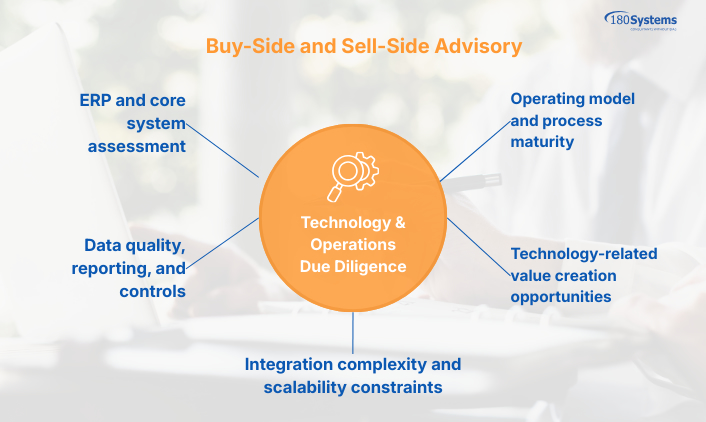
We conduct technology due diligence as part of our broader M&A advisory services to help buyers understand what they are acquiring and sellers prepare for scrutiny. Our approach is grounded in how the business actually operates, not theoretical architecture reviews.
Typical technology due diligence scope includes:
- ERP and core system assessment
- Data quality, reporting, and controls
- Integration complexity and scalability constraints
- Operating model and process maturity
- Technology-related value creation opportunities
Our diligence outputs are designed to support investment decisions, valuation discussions, and integration planning.
Post-Close Discovery & Stabilization
Clarity when technology due diligence was constrained
Post-close discovery and stabilization is an M&A advisory service used immediately after a transaction closes, when the buyer owns the business but does not yet have sufficient clarity to safely integrate. This situation most often arises when diligence timelines were compressed, scope was limited, or technology and operations were reviewed by others without an execution lens.
Our role at this stage is not to redesign the business or accelerate transformation. It is to establish control, protect continuity, and create a reliable fact base before irreversible integration decisions are made.
This phase focuses on:
- Confirming what was acquired versus retained across systems, data, vendors, and contracts
- Identifying shared dependencies that create hidden Day 1 and Day 30 risk
- Protecting operational continuity while ownership transitions
- Establishing guardrails that prevent premature system changes or integration missteps
Our role at this stage is not to redesign the business or accelerate transformation. It is to establish control, protect continuity, and create a reliable fact base before irreversible integration decisions are made.
This work reduces surprise risk, prevents premature system changes, and enables informed sequencing decisions grounded in how the business actually operates.
Integration Readiness & PMI Support
Decision support before execution
As part of our M&A advisory services, we support integration readiness by helping deal teams determine what to integrate, when to integrate, and why. Our role is to structure integration sequencing and risk mitigation before execution begins.
This typically includes:
- Integration sequencing and dependency mapping
- Identification of high-risk changes to defer
- Day 1 and early post-close priority definition
- Clean handoff to PMI or implementation teams
We do not lead large-scale system implementations as part of diligence or stabilization. Our role as an M&A advisory firm is to enable informed, low-risk execution.

Value Creation Enablement
Non-transformational, execution-aware
We help deal teams identify practical, near-term value opportunities aligned with the investment thesis and hold-period objectives. This aspect of our M&A advisory focuses on enablement and optimization rather than enterprise transformation.
Examples include:
- Automation opportunities within existing systems
- Reporting and data improvements
- Process simplification and scalability enhancements
- System consolidation opportunities aligned to timing and risk
Who We Work With

Our M&A advisory services primarily support:
– Private equity deal teams
– Corporate development teams
– Portfolio company leadership post-close
Our work is best suited for:
– Middle-market transactions
– Situations where continuity and risk management matter more than speed
Working Alongside Your Deal Team
We work alongside financial, legal, and tax advisors to ensure technology and operations risks are understood and appropriately addressed. Our role complements financial diligence and helps translate findings into operational reality.

Technology risk is not fully covered in financial diligence

Integration complexity is underestimated

Buyers want independent, implementation-agnostic advice
Frequently Asked Questions
What is the role of M&A Advisory in a technology-driven transaction?
M&A Advisory helps organizations evaluate, structure, and execute acquisitions while identifying risks that may affect deal value. In technology-driven transactions, this often includes assessing IT systems, data architecture, cybersecurity posture, and operational scalability. Strong M&A Advisory firms ensure that technology risks and opportunities are clearly understood before the deal closes, reducing integration surprises and protecting expected synergies.
Why is Technology Due Diligence important in mergers and acquisitions?
Technology Due Diligence evaluates the systems, infrastructure, and technical capabilities of a target company before an acquisition. It helps investors and corporate buyers understand whether the technology environment can support growth, integration, and operational stability. Many M&A Advisory firms include Technology Due Diligence as part of their process to uncover hidden costs, security risks, and integration complexity that could affect deal value.
How do M&A Advisory firms evaluate technology risk during due diligence?
Leading M&A Advisory firms use a structured approach that combines interviews with technical leaders, system architecture reviews, and assessments of security, scalability, and operational dependencies. As part of Technology Due Diligence, advisors also evaluate integration complexity, legacy system risks, data quality, and the potential cost of modernization. The goal is to translate technical findings into clear business implications for the deal.
What technology issues commonly emerge during Technology Due Diligence?
During Technology Due Diligence, common issues include outdated infrastructure, undocumented integrations, cybersecurity vulnerabilities, and heavy reliance on manual processes. These risks can affect integration timelines, operational stability, and post-close investment requirements. Experienced M&A Advisory firms identify these issues early so buyers can adjust valuation, plan integration strategies, or negotiate transaction terms accordingly.
What technology issues commonly emerge during Technology Due Diligence?
During Technology Due Diligence, common issues include outdated infrastructure, undocumented integrations, cybersecurity vulnerabilities, and heavy reliance on manual processes. These risks can affect integration timelines, operational stability, and post-close investment requirements. Experienced M&A Advisory firms identify these issues early so buyers can adjust valuation, plan integration strategies, or negotiate transaction terms accordingly.
How are M&A Advisory firms different from ERP consulting firms?
While ERP consulting firms focus primarily on software selection and implementation, M&A Advisory firms evaluate technology from a transaction perspective. Through Technology Due Diligence, advisors assess how systems, infrastructure, and data environments affect deal risk, integration complexity, and long-term scalability.
Can M&A Advisory firms support ERP selection after an acquisition?
Yes. Many M&A Advisory firms help organizations evaluate enterprise systems after a transaction. Following Technology Due Diligence, advisors may support ERP selection, system consolidation, or modernization initiatives required to integrate operations across the combined organization.
How long does Technology Due Diligence typically take?
The duration of Technology Due Diligence depends on the complexity of the target company’s systems and infrastructure. Most reviews conducted by M&A Advisory firms take between two and six weeks and include system assessments, stakeholder interviews, and integration risk analysis.
Working Alongside Your Deal Team
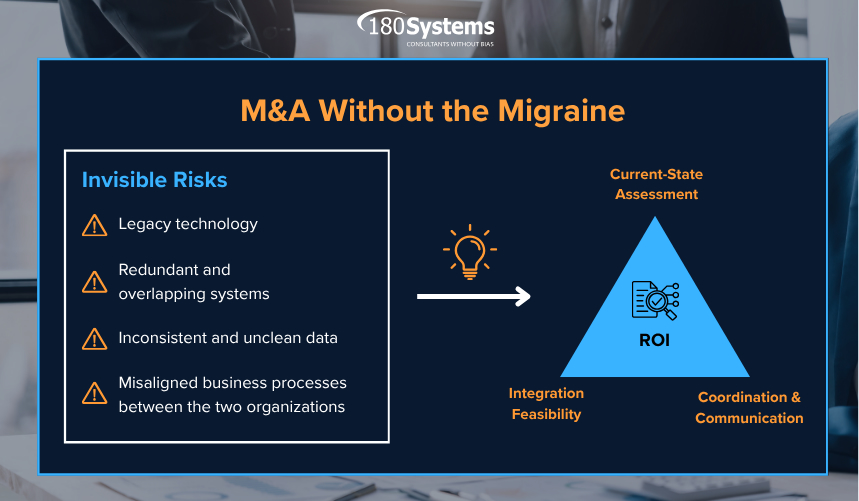
M&A Without the Migraine
Everyone loves a merger until someone opens the shared drive. Suddenly, the spreadsheets do not match...
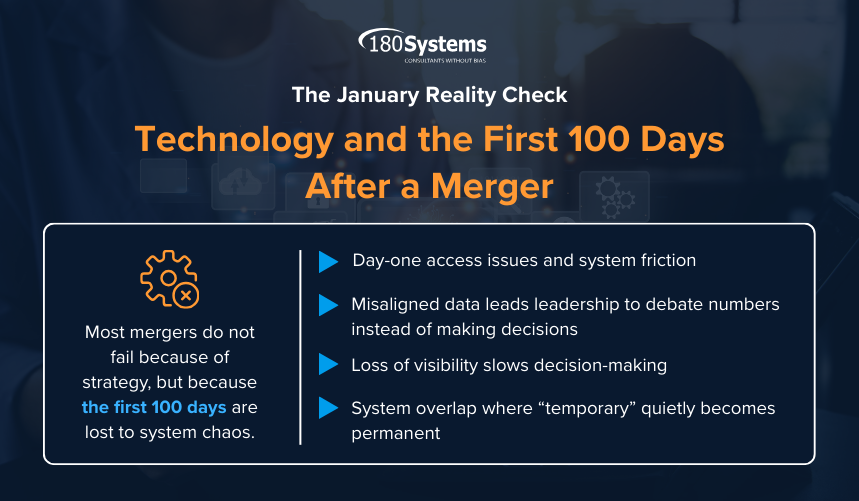
The January Reality Check: Technology and the First 100 Days After a Merger
January has a way of sobering everyone up. The decorations come down, inboxes refill...
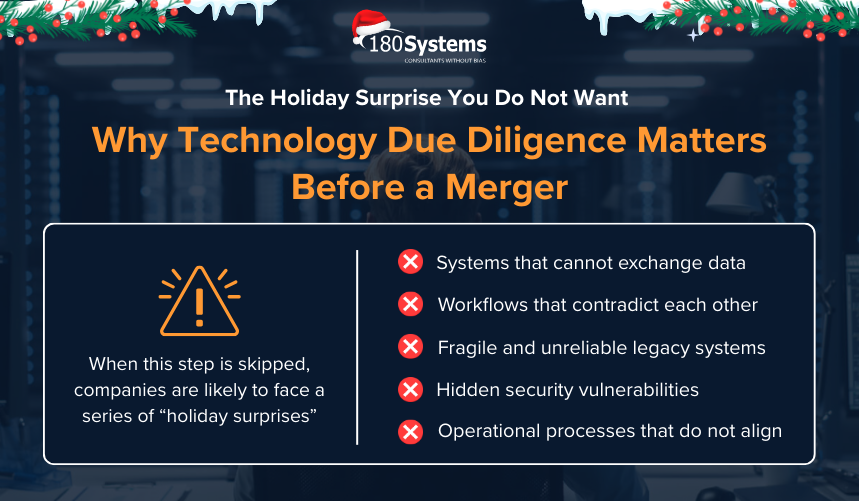
The Holiday Surprise You Do Not Want: Why Technology Due Diligence Matters Before a Merger
Some consultants will identify the top 10 ERP systems or just consider them...