
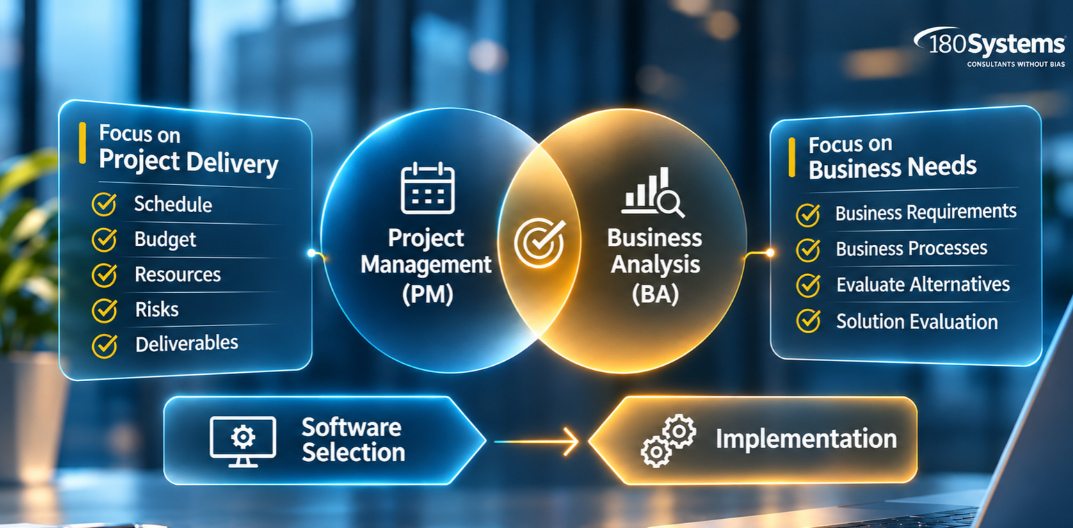
Project Managers (PMs) play a critical role in the success of ERP and other business software projects. They are responsible for managing schedules, budgets, resources, risks, and deliverables. But is that enough? Should Project Managers also possess Business Analysis (BA) skills?
At 180 Systems, we believe the answer is yes. While Project Management and Business Analysis are distinct disciplines, PMs who possess strong BA skills are better equipped to manage ERP software selection and implementation projects successfully.
The Difference Between a PM and a BA
Traditionally, Project Managers focus on how a project is delivered, while Business Analysts focus on what the business needs and why.
A Project Manager is primarily responsible for ensuring that a project is completed on time, within budget, and according to the agreed scope. A Business Analyst is responsible for understanding business processes, identifying requirements, evaluating alternatives, and ensuring that the proposed solution addresses business needs.
These responsibilities are complementary, and there is considerable overlap between them.
For example, both PMs and BAs need strong communication, problem-solving, and stakeholder management skills. Both must understand business objectives and recognize risks that could compromise the project’s success.
However, a PM who lacks BA skills may be able to manage the project plan without fully understanding whether the project is delivering the right solution.
Why PMs Need BA Skills
Consider an ERP implementation where the software vendor recommends customizing the system to accommodate an existing business process.
A PM without BA skills might focus on the cost of the customization, its impact on the schedule, and the resources required.
A PM with BA skills would go further and ask:
- Is the customization necessary to meet a legitimate business requirement?
- Could the business process be changed to take advantage of standard ERP functionality?
- Are there alternative ways to configure the software?
- What are the implications for other business processes?
- Does the business value justify the additional cost and complexity?
These questions could lead to a better solution, lower costs, and reduced implementation risks.
Similarly, when requirements are unclear or conflicting, a PM with BA skills is better positioned to recognize the problem before it results in delays, additional costs, or an unsatisfactory implementation.
Our Approach
We are getting our PMs involved in the software selection process. They attend demonstrations and evaluate whether the requirements in the script were demonstrated and to what extent. This requires the PMs not only to understand the requirements, but also to understand the differences between systems and what is a strength and what is a weakness. When the implementation starts, our PMs are locked and loaded.