
I have always admired people who restore old homes. Not the television version where someone walks through the front door, knocks down three walls, installs a kitchen the size of a small airport, and declares the house “modernized.” I mean the people who spend hours carefully restoring the original hardwood floors, repairing old stained-glass windows, or bringing century-old brickwork back to life. They understand something that is surprisingly easy to forget. Just because something is old or different doesn’t mean it needs replacing. Sometimes the goal isn’t to make the house look new. Sometimes the goal is to preserve the very character that made you fall in love with it. The more acquisitions I work on, the more I think integration teams could borrow that mindset.
Every acquisition begins with admiration. During due diligence, we enthusiastically explain why this company is worth buying. We talk about its entrepreneurial culture, loyal customers, talented employees, innovative products, or its ability to move faster than competitors. Those differences aren’t viewed as obstacles. They become part of the investment thesis. In many cases, they are exactly what justifies the purchase price. Then something interesting happens after the deal closes.
Without anyone consciously deciding to do it, the conversation begins to change. The same entrepreneurial culture that impressed everyone during diligence suddenly feels a little too informal. Decision-making should probably become more structured. Customer interactions need greater consistency. Reporting should align with corporate standards. The technology needs replacing because that’s what everyone else uses. One decision at a time, each one perfectly reasonable on its own, we slowly begin renovating the very things we admired only a few months earlier.
I don’t believe this happens because integration teams are trying to erase what made the company successful. In fact, I think the opposite is true. Most integration professionals are genuinely trying to create value. The difficulty is that standardization is tangible. You can point to a single ERP system, one reporting structure, or a common set of policies and confidently say, “We’ve integrated.” Protecting a culture, preserving customer relationships, or deliberately choosing not to change something rarely appears as a milestone on a project plan, even though it may create just as much value. What has changed my thinking over the years is realizing that difference and dysfunction are not the same thing.
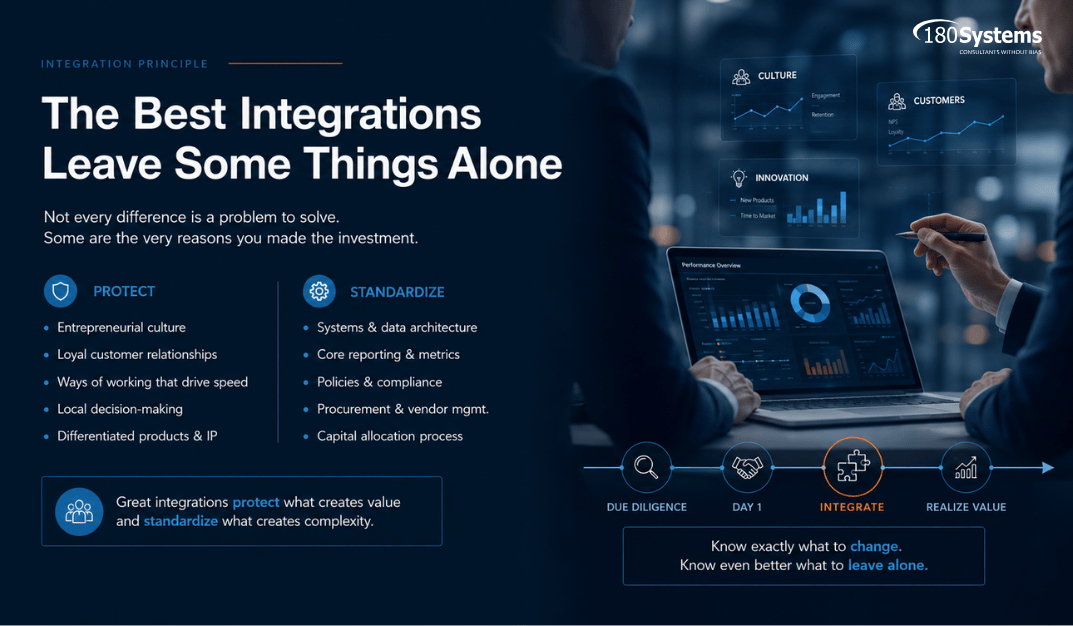
Some differences absolutely create unnecessary complexity. Others are the reason customers stay loyal, employees remain engaged, and innovation happens more quickly than larger organizations expect. The challenge is that they often look remarkably similar when you’re reviewing an integration checklist. Both appear under the heading of “things that are different.” The real work of leadership is figuring out which differences deserve attention and which deserve protection.
That requires a different kind of discipline than most integration playbooks teach. It is easy to standardize because consistency feels productive. It is much harder to pause long enough to ask why something evolved the way it did and whether changing it will actually improve the business. Sometimes the answer is yes. Sometimes the answer is no. The difficult part is resisting the temptation to assume that familiar automatically means better.
I’ve started to think that the best integration leaders have something in common with great restoration architects. They don’t preserve everything simply because it’s old, and they don’t replace everything simply because it’s different. They understand the history before deciding what belongs in the future. They know that real value isn’t created by making every room look the same. It comes from recognizing which features give the building its character and making sure those are still there when the work is finished.
Perhaps acquisitions deserve the same respect. Because the best integrations are rarely the ones that change the most. They’re the ones that know exactly what to leave alone.