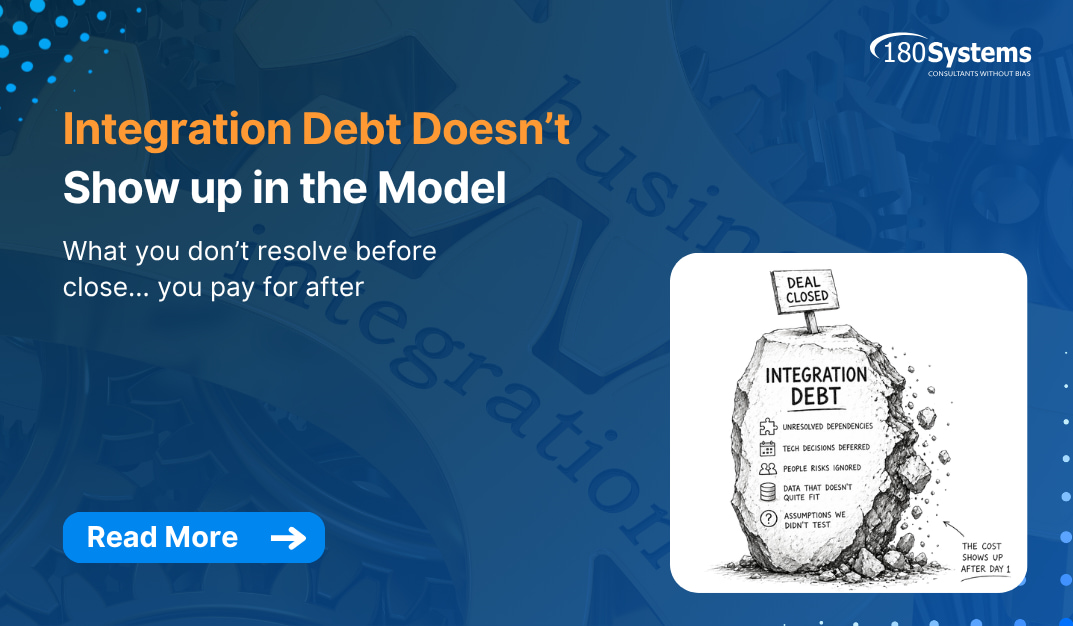
Everyone talks about technical debt, but almost no one talks about integration debt. Which is interesting, because if you have been through a few deals, you have definitely paid for it. Just not when you expected to.
Integration debt is what you carry into Day 1 because you did not resolve it before close. It shows up as unvalidated assumptions, dependencies that were “understood” but never fully mapped, technology decisions that got pushed, and people risks that felt just uncomfortable enough to avoid. None of it feels critical in the moment. The deal is moving, the model holds, and nobody wants to be the person slowing things down. So it gets noted, maybe even documented, and then quietly carried forward.
Day 1 arrives, and those same items start behaving differently. Systems that looked compatible on paper need workarounds. Processes that sounded aligned behave just differently enough to create friction. Data does not quite reconcile, but not enough to stop anything, just enough to slow everything down. Nothing is broken, which makes it harder to call out. Things are working, just not as easily as expected.
A few weeks in, it starts to show up in ways that are harder to ignore. Reports take longer to produce, and no one can quite explain why. Teams start doing the same work twice just to be safe. Decisions that should take hours stretch into days because no one fully trusts the inputs. Progress is still being reported, but more effort is going into holding things together than moving things forward.
This is where the cost becomes real. Not as a single issue, but as a pattern. Workarounds get introduced to keep momentum. Parallel processes stay in place longer than planned. People start relying on side conversations to get clarity because the system does not quite reflect reality. None of this shows up as failure. It shows up as drag. And drag is easy to tolerate, because technically, everything is still moving.
What makes this uncomfortable is that most of this was visible earlier. These risks come up during diligence, they get mentioned in discussions, and in some cases they even make it into slides. But they rarely change the direction of the deal. If the numbers still work, the issues get accepted. Which means they are not actually addressed. They are transferred.
Once the deal closes, the cost of resolving those same issues goes up. Timelines tighten, expectations rise, and the people responsible for execution are now working within constraints they did not define. So, the organization adapts. Not by fixing everything, but by working around it.
The teams that perform differently are not immune to this. They still carry some level of integration debt, because that is often unavoidable. The difference is that they are deliberate about it. They push harder on assumptions that feel “close enough,” they resolve what they can earlier, and they make conscious decisions about what they are willing to carry forward.
Because once the deal closes, you are not starting fresh. You are starting with everything you chose not to deal with. Where have you seen integration debt show up most clearly, and when did you realize you were already carrying it?