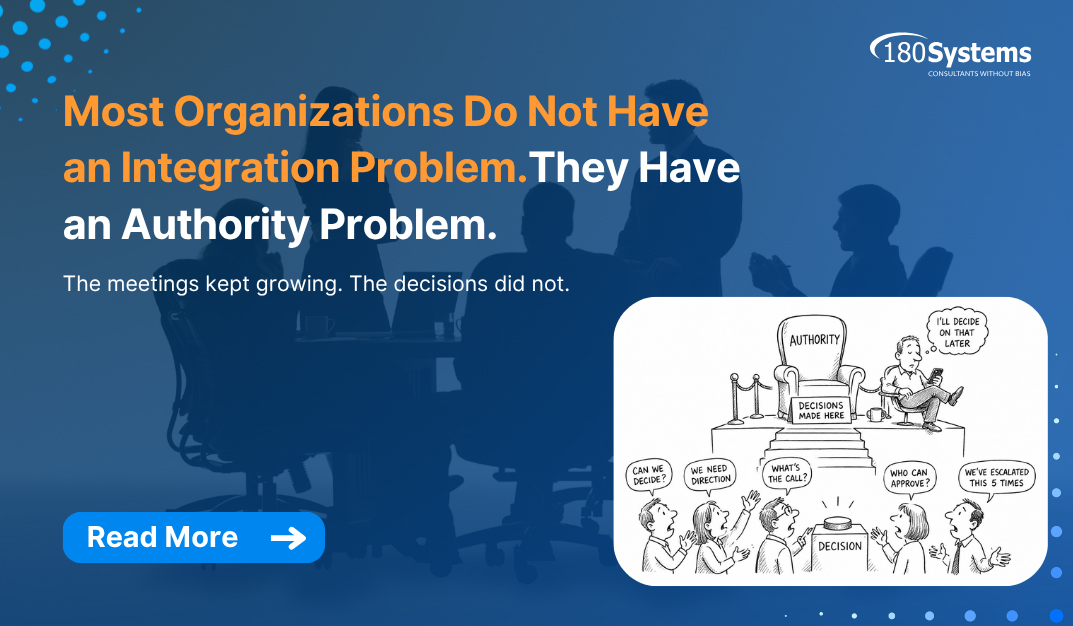
One of the things that has always fascinated me about integrations is how quickly very sophisticated organizations can suddenly start behaving like a stressed family trying to assemble IKEA furniture without instructions. Everybody is present and has opinions, but nobody wants to admit they are confused, and at least one person is quietly questioning every life decision that brought them into the meeting.
At the beginning, integrations usually feel incredibly organized. The organization moves with the confidence of something that still believes planning and execution are basically the same activity. Leadership feels aligned, and the deal rationale still sounds compelling. Every discussion carries the reassuring tone of people who assume the difficult parts can be solved later. From the outside, it all looks very mature, largely because the synergy model has not yet met operational reality face-to-face. Then the organization reaches the point where the easy conversations are over and the real decisions start showing up.
Not the nice theoretical ones everyone nods through in steering committee meetings, but the uncomfortable ones where somebody’s process changes, somebody loses control, somebody’s system gets retired, and suddenly the integration feels a lot more real than it did in the PowerPoint.
Suddenly, people need to decide which systems survive, and which reporting structures to change. Leadership teams are required to absorb the combined function, and decide which processes become standardized across both businesses. Even small decisions become emotional very quickly once teams realize that “integration” often means letting go of ways of working they spent years building and defending.
That is usually the moment where integrations start slowing down, unfortunately, because this is where organizations discover that governance and authority are not the same thing.
Most organizations are very good at governance. And we all know that corporate environments love governance. We will create steering committees to oversee governance structures designed to support alignment discussions for future decision-making sessions. We will put fifteen people in a meeting to review a slide deck explaining why nobody has approved the thing the slide deck is talking about. We will schedule pre-alignment meetings before executive alignment meetings because, apparently, alignment itself now requires preparation work.
What organizations are much less comfortable with is authority, I have noticed. Authority means somebody eventually has to make a decision that another department may dislike. It means leaders have to accept trade-offs, move through ambiguity, and acknowledge that two organizations cannot both continue doing everything “their way” forever. That is the point where integration stops feeling strategic and starts feeling personal.
This becomes especially painful because integration leaders are usually handed all the responsibility without nearly enough authority to match it. They are expected to somehow keep the integration moving, hit timelines, deliver synergies, calm nervous customers, and stop the business from spiralling into chaos, but the biggest decisions are still sitting with executives who are already drowning in their actual day jobs.
So what ends up happening is the integration team spends weeks chasing approvals, repeating the same conversation to five different groups, and writing status updates with phrases like “pending alignment,” which usually means everyone agrees it is important, but nobody wants to be the person to make the call.
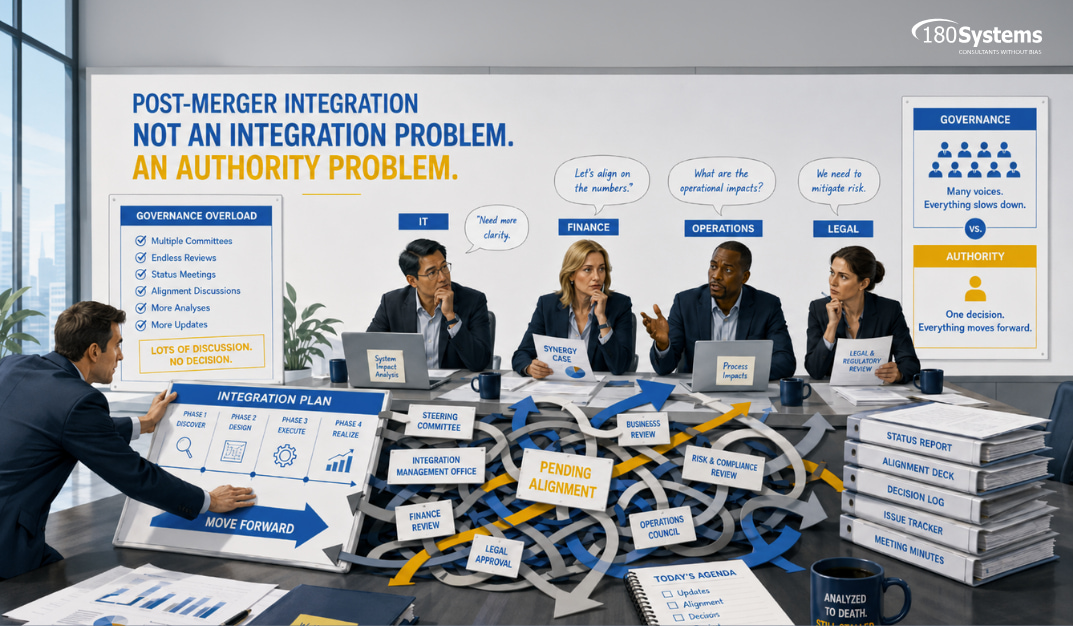
Meanwhile, the organization slowly begins confusing activity with progress. Meetings multiply almost automatically, as though enough calendar invites will eventually force clarity into existence. Escalations follow close behind, then more reporting, then increasingly elaborate discussions about the reporting related to the escalations. Before long, someone proposes a subcommittee, which is usually the corporate equivalent of admitting nobody wants to make the original decision. At that point the delays start feeding each other. IT is waiting on Finance, Finance is waiting on Operations, Operations is waiting on Legal, and Legal would feel more comfortable after one additional executive review. The executive review, naturally, gets pushed to next week because half the leadership team is traveling and the other half would “like more context.” By this stage, everyone is technically working very hard, but very little is actually moving.
What makes this frustrating is that most organizations are not lacking intelligence. Most teams already understand the operational problems in front of them. They usually know which process should be standardized, which systems need to change, which reporting structure makes sense, and where the integration friction is coming from. The real issue is that unresolved authority creates organizational drag, and organizational drag compounds very quickly during integrations because every unresolved decision creates downstream delays somewhere else.
Eventually the integration team starts building temporary workarounds simply to keep the business functioning. Customer issues take longer to resolve, and teams become frustrated. Key people disengage because uncertainty stretches longer than expected. Leaders begin spending more time managing friction than moving the integration forward. The synergy targets still exist inside the PowerPoint presentation, but operationally, the organization has lost momentum trying to navigate decisions that should have been resolved weeks earlier.
The organizations that integrate well are usually not the organizations with the prettiest integration playbooks. They are the organizations that create clarity early and let people know who can decide, what gets escalated, how quickly decisions need to happen. And exactly who is accountable when the trade-offs become uncomfortable. There is far less organizational theatre because the decision-making structure is designed to move the business forward instead of endlessly protecting consensus.
That is why I have started to believe that many integrations do not really fail because of planning problems. They fail because organizations underestimate how much operational momentum depends on decision-making clarity once complexity arrives.
And unfortunately, complexity always arrives.