
Every acquisition seems to end in a familiar way. The major milestones have been completed, the critical systems are working well enough to support the business, and the integration team is finally able to take a breath. After months of navigating difficult decisions, competing priorities, and the inevitable surprises that accompany every acquisition, there is a sense that the hardest part is finally over. It is usually at that point that someone suggests holding a lessons learned meeting before everyone disappears back into their day jobs.
I have attended many of those meetings over the years, and they are almost always worthwhile. People are honest. They talk openly about what worked, what did not, which assumptions proved wrong, and which decisions took far longer than anyone expected. Someone captures pages of notes, action items are assigned, and there is a genuine belief that the next acquisition will benefit from everything the team has just learned.
Then life happens. Operational priorities return, the integration team disbands, people move into other roles, and the document is carefully saved in a shared folder that everyone intends to revisit. Months later another acquisition begins. Before long, a familiar issue appears, someone looks around the room and asks, ‘Didn’t we run into this exact problem last time?’ That question has always fascinated me because it says far more about the organization than it does about the integration.
What I have found, both in practice and throughout my doctoral research, is that most organizations are not short on insight. Integration teams usually know exactly what happened, why it happened, and what they would do differently. The challenge is not generating lessons. The challenge is making sure those lessons survive long enough to influence the next acquisition.
That distinction matters because knowledge often stays with the people rather than becoming part of the organization. As long as the same project manager, integration lead, and workstream leaders are around, everything feels fine. They remember why a decision was made, which governance approach worked, and where the real bottlenecks were. But organizations change. People retire, accept new opportunities, or move into different roles. Before long, years of hard-earned experience quietly walks out the door with them.
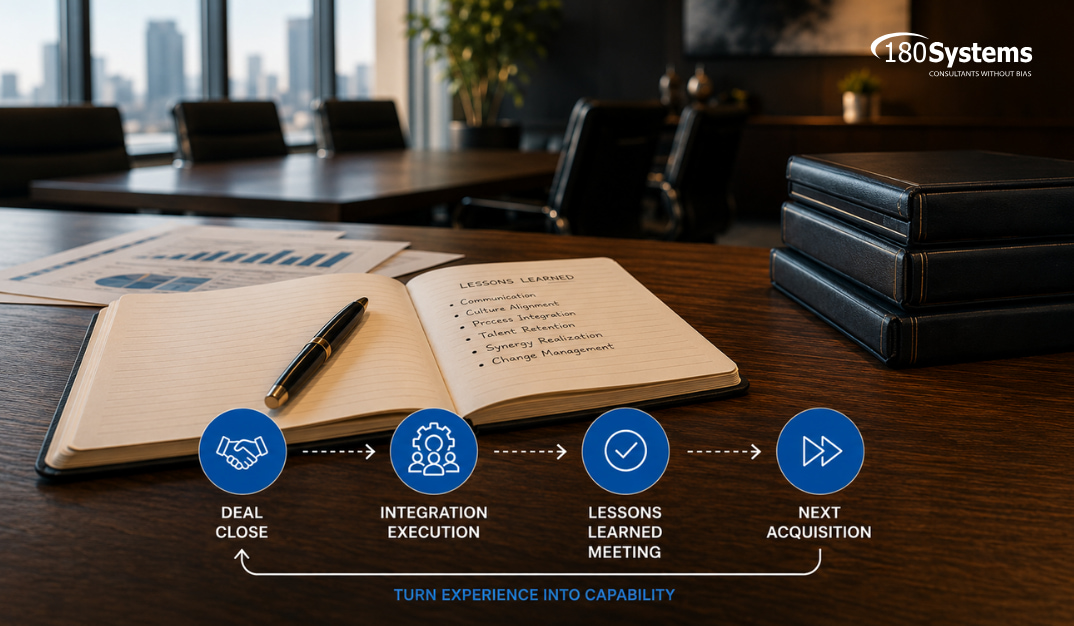
I have become convinced that one of the biggest differences between occasional acquirers and organizations that consistently integrate well is not intelligence, talent, or even the number of acquisitions they have completed. It is their ability to remember. The strongest serial acquirers deliberately turn experience into capability. They update playbooks, refine governance, document not only what decisions were made but why they were made, and make those lessons available before the next deal begins rather than after the same problem has already resurfaced.
Experienced integration leaders develop something that is difficult to teach but immediately recognizable: pattern recognition. They can often see a governance issue, an unrealistic assumption, or a technology dependency long before everyone else because they have seen the movie before. The challenge for organizations is ensuring that this pattern recognition becomes an organizational capability instead of remaining a personal one.
That is why I have started looking at lessons learned meetings differently. They are not really the last meeting of the current integration. They are the first meeting of the next one. The real value is not the discussion itself but what the organization chooses to do with the knowledge that comes out of it. If those insights simply become another document on a shared drive, the meeting was useful but not transformational. If they reshape how the next acquisition is planned and executed, they become one of the highest-return investments an organization can make.
Every acquisition creates experience. The organizations that improve are the ones that deliberately convert that experience into capability. They do not become better because they avoid mistakes. They become better because they refuse to pay for the same lesson twice.