One of the things that has always fascinated me about integration meetings is that you can leave the room feeling surprisingly optimistic while unknowingly creating tomorrow’s problems.
Everyone has contributed and every concern has been addressed: the meeting ends on time, action items are assigned, and there is a quiet sense that real progress has been made. If someone had wandered into the room during the last five minutes, they probably would have assumed the integration was in excellent shape. Then, a few months later, people begin asking why the expected value hasn’t materialized.
Over the years, I’ve started to think that one of the reasons is surprisingly simple. We spend a great deal of time making good decisions, but not nearly enough time asking whether those good decisions still make sense once they are combined with every other good decision being made across the organization. That sounds strange at first, but bear with me.
Imagine a family trying to decide where to go for dinner. One person wants Italian because they had Mexican yesterday. Someone else wants sushi because they’re trying to eat healthier. Another votes for a steakhouse because they’ve had a long week and feel they’ve earned it. A child enthusiastically suggests ice cream for dinner, which, to be fair, is probably the most honest contribution to the discussion. None of those opinions is unreasonable. In fact, each one makes perfect sense when viewed on its own. The challenge is that the family still has to eat at the same restaurant; integration has a habit of feeling very similar.

Every function arrives with responsibilities it genuinely needs to protect. Nobody wakes up in the morning hoping to make the acquisition more difficult. People are doing exactly what experienced professionals should do. They are identifying risks, protecting customers, maintaining operational stability, ensuring compliance, controlling costs, and trying to leave the organization stronger than they found it. If you listened to each conversation independently, you would probably agree with almost every recommendation. The difficulty is that organizations do not experience integration one function at a time, they experience every decision at once and that’s where things become interesting.
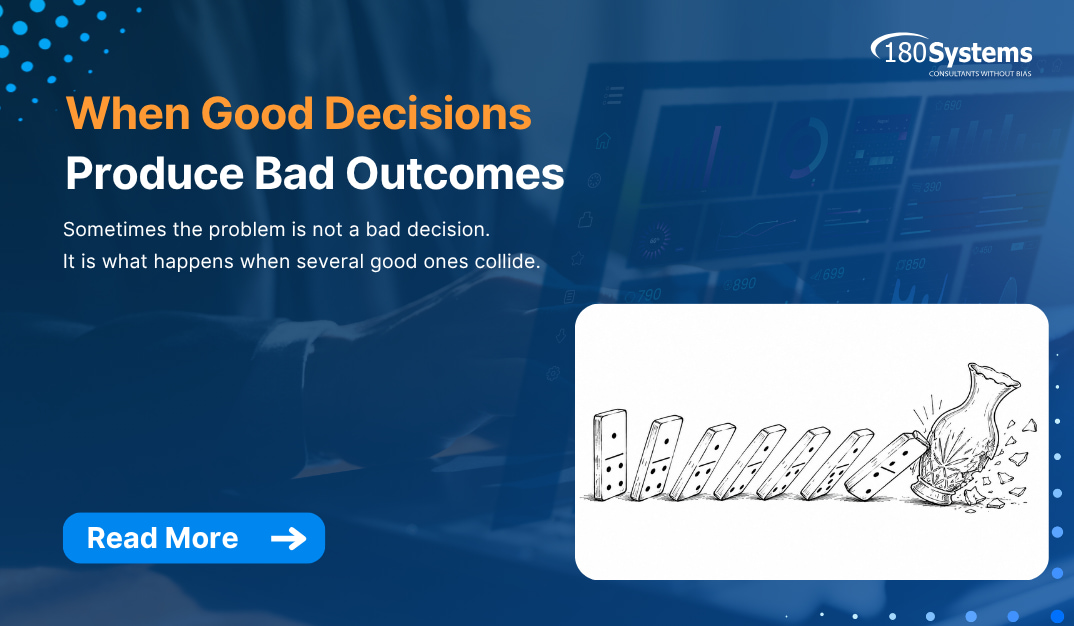
A decision that looks perfectly reasonable from one perspective can quietly create friction somewhere else. None of those decisions is large enough to cause concern on its own, but together they begin changing the rhythm of the organization. Processes become a little slower. Decisions require one more approval. Customer requests take another day to resolve. Teams begin working harder yet somehow feel like they are accomplishing less. Nobody can point to the single decision that caused it because there wasn’t one. The outcome was created by dozens of individually sensible decisions that were never viewed together. I sometimes wonder whether this is one of the hardest parts of leadership. Not making the right decision but recognizing when a collection of right decisions is quietly producing the wrong outcome.
That requires a different way of thinking. It asks leaders to look beyond their own responsibilities and consider how their decisions interact with everyone else’s. It is less about defending a function and more about understanding the organization as a living system where every adjustment influences something else. The best leaders I’ve worked with seem to have an instinct for this. They are remarkably comfortable saying, “That is a good idea, but I’m not sure it is the right idea for the organization.”
I have come to believe that this is where integration leadership quietly separates itself from integration management. Managing integration is about making sure work gets done. Leading integration is about making sure all of that work is moving the organization in the same direction. Those sound similar, but they are very different skills.
Perhaps that is why the strongest integration leaders are rarely remembered for winning every debate. They are remembered for creating an environment where the organization won, even if every individual function didn’t get everything it wanted. Looking back, I suspect that is one of the most expensive mistakes organizations make during integration. We celebrate winning individual arguments without realizing the organization has quietly lost the larger one.