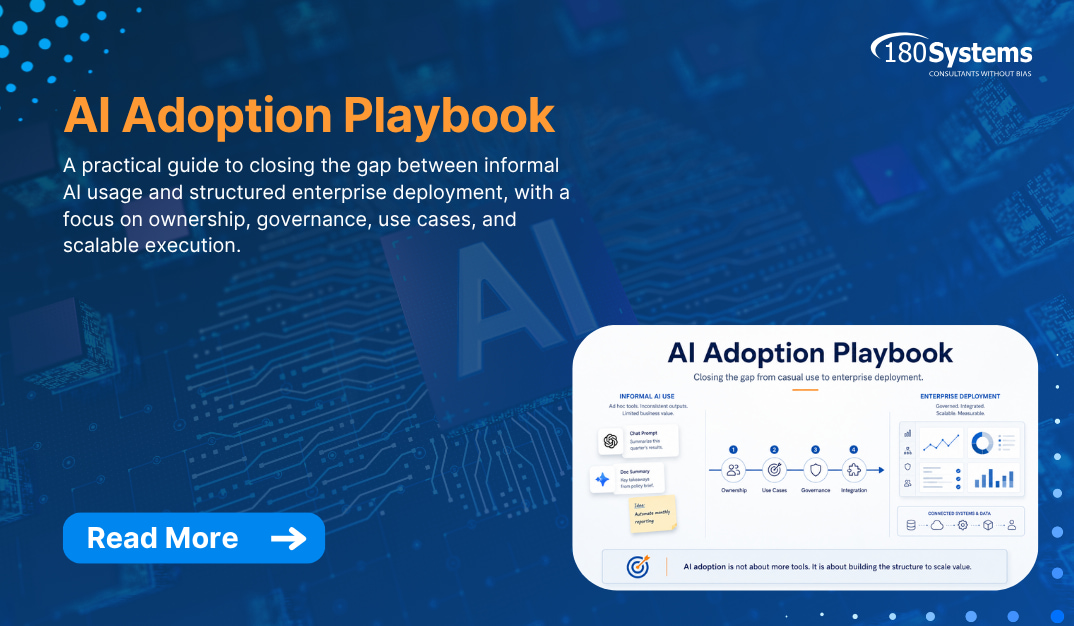
Closing the gap from casual use to enterprise deployment.
Most organizations use AI informally. Individuals might be using AI to complete initial research, draft content, or summarize documents, but there is a clear gap between using AI at this level and deploying AI for enterprise-wide adoption. That gap is not driven by technology limitations. It is driven by a lack of structure, ownership, and alignment.
The issue starts without a clear plan, no defined ownership or agreed use cases, and no alignment on tools. AI usage grows organically, driven by individuals rather than business priorities. As a result, organizations accumulate fragmented usage. Tools vary by user, outputs are inconsistent, and there is no clear link to measurable outcomes or core processes.
Closing this gap requires structure before scale. Internal ownership must be defined with a core team, and the initiative needs to be treated as a formal transformation effort, similar to an ERP implementation. Use cases must be tied to specific business processes, not general productivity. The AI platform and implementer should be selected based on defined requirements and decision criteria rather than individual preference. Policy and governance also need to be established early. This includes clear guidelines on data usage, confidentiality, access, and expected outputs. Without this definition work upfront, it is not possible to standardize or scale usage across the organization.
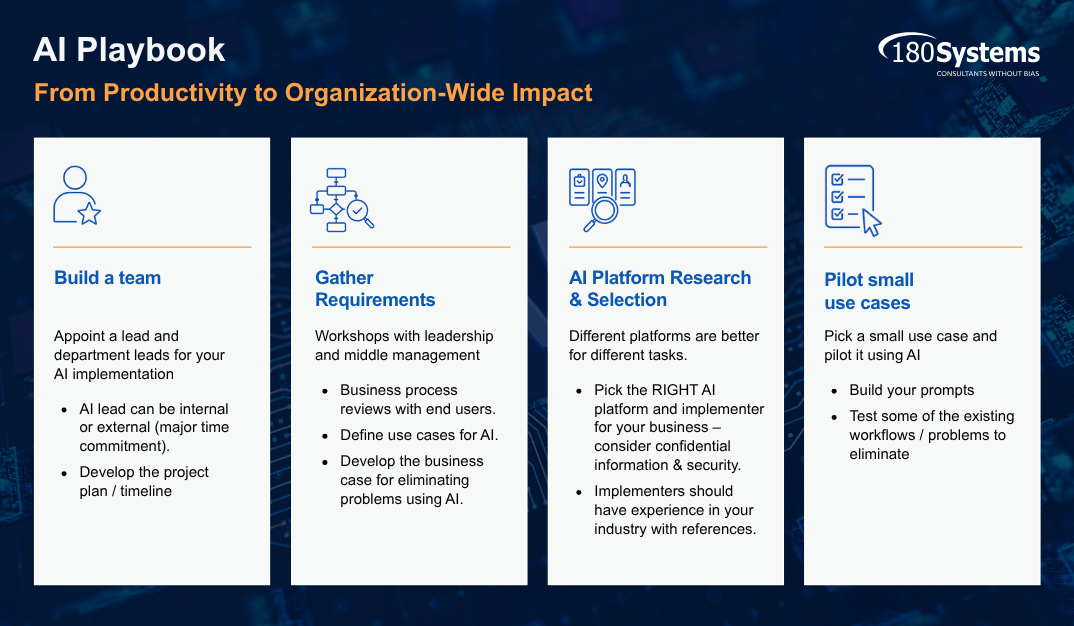
Once this structure is in place, pilots can be executed in a controlled way. A small number of focused use cases are tested against specific processes to determine whether AI can reduce effort, improve consistency, or support decision-making. The objective is to validate outcomes and establish a repeatable approach to deployment.
Scaling then shifts to execution. AI is embedded into workflows and systems through licensing, structured configurations, and agents connected to core platforms such as ERP or document management systems. Tools are deployed with defined roles, permissions, and standard instructions. This is where AI moves from individual usage into the operating model and begins to impact day-to-day execution. Monitoring and refinement become ongoing requirements to maintain performance and control risk.
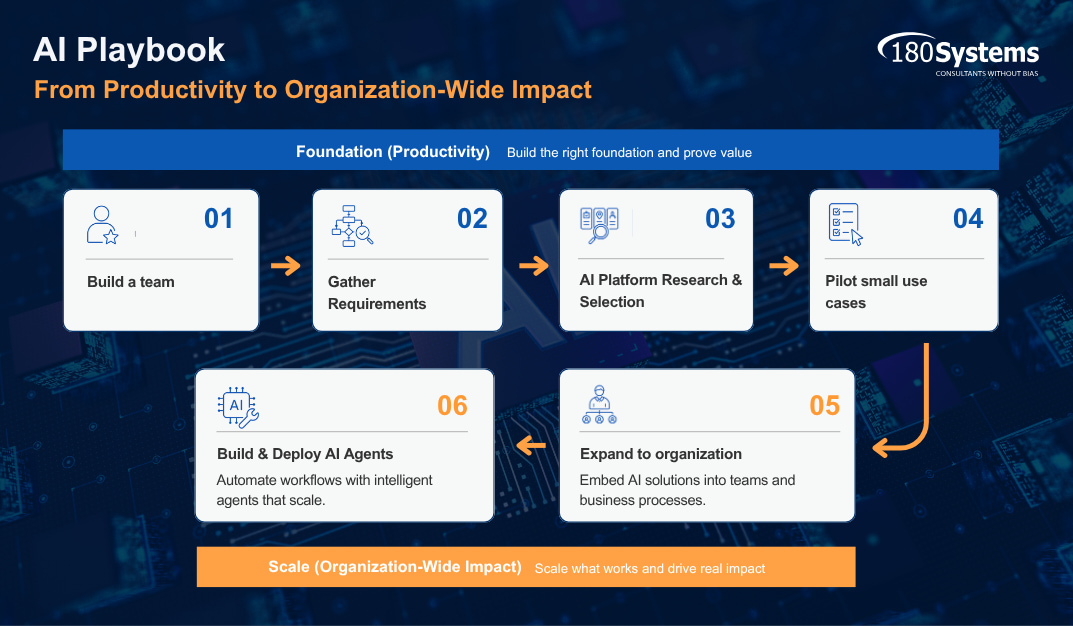
Six-step adoption model
- Build a team and define ownership
- Gather requirements and define use cases
- Complete AI platform & Implementer selection
- Pilot small, focused use cases
- Expand across the organization
- Build and deploy AI agents
The model is sequential by design. Structure at each stage determines whether AI remains a tool used by individuals or becomes part of how the organization operates.