
One of the strangest things about acquisitions is how much time we spend evaluating the company we are buying and how little time we spend evaluating ourselves. I have sat through diligence processes where teams reviewed financial statements, technology platforms, customer concentration, contracts, operating processes, management capability, and enough spreadsheets to make even the most committed Excel person consider a career in pottery. Every risk is catalogued, discussed, scored, challenged, and placed neatly into some colour-coded document that gives everyone a brief sense of control.
Then the deal closes, and suddenly the organization that spent months examining someone else’s weaknesses is confronted with a few of its own. The buyer assumes it is the stable one, the capable one, the one with the strategy, the capital, and the plan. And sometimes it is. But acquisitions have a funny way of testing the acquiring company just as much as the company being acquired. More specifically, they test the acquiring leadership team, and that is not usually something anyone has assessed with the same discipline applied to the target.
Why Leadership Due Diligence Gets Skipped
This idea had been sitting in the back of my mind for a while, mostly because I have seen it play out in practice. We could spend enormous energy assessing the acquired business, only to discover after close that many of the hardest issues were not really sitting inside the target. They were sitting inside our own decision-making habits, our own communication patterns, our own capacity constraints, and our own ability to stay focused once the excitement of the announcement faded. Nobody puts that neatly into a diligence tracker, unfortunately. Although honestly, maybe they should.
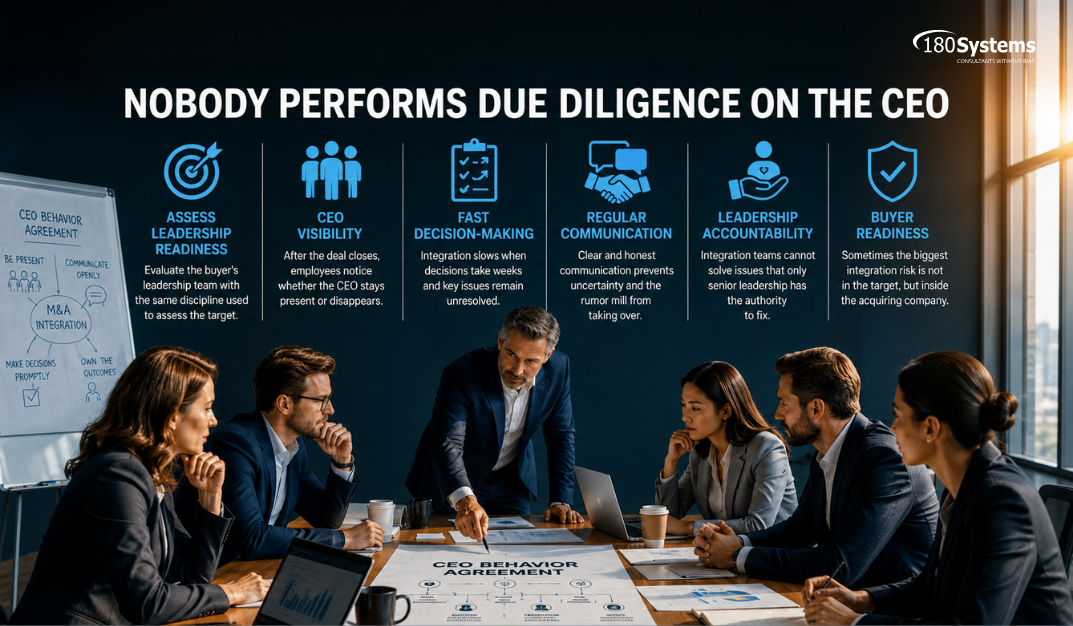
I was reminded of this recently during a conversation with Jim Jeffries, founder of the M&A Leadership Council. We were talking about integration success, and he mentioned something I had never heard before a CEO behavior agreement. At first, I thought I had misheard him, because a CEO behavior agreement sounded like something HR would create after an unfortunate Christmas party incident. But the more he explained it, the more it made sense. The agreement was not about financial models or synergy targets. It was about how the CEO was expected to behave during the integration. Would the CEO remain visible? Would communication be regular? Would decisions be made quickly? Would leadership stay engaged instead of quietly handing the whole thing to an already exhausted integration team and hoping for the best?
That stopped me, because so many integration challenges I have seen were not caused by the absence of a plan. The plans usually exist. There are workstreams, steering committees, communication schedules, risk logs, and beautifully formatted presentations that suggest the organization is very much in control. The real test begins when employees start asking what changes, customers want reassurance, suppliers want clarity, department leaders need decisions, and the integration team starts realizing that many of the questions landing on their desk cannot actually be answered by the integration team alone.
How Leadership Behavior Shapes Integration Performance
That is where leadership behavior becomes impossible to separate from integration performance. If the CEO disappears after the announcement, people notice. If decisions take weeks, the organization slows down. If communication becomes vague or irregular, people fill the silence with their own theories, and let me tell you, the employee rumor mill has never once chosen the calmest possible interpretation. If leaders avoid uncomfortable conversations because they are hoping things will settle on their own, the integration does not become easier. It just becomes quieter for a while, which is not the same thing as better.
What I found powerful about Jim’s point was that it treated leadership behavior as something that could be designed, discussed, and committed to before the pressure arrived. That is very different from assuming leadership will naturally show up in the right way after close. In one of the examples he shared, the CEO chaired the steering committee, communication was regular, decisions were made quickly, and accountability stayed clear. The organization understood that integration was not being managed somewhere off to the side. Leadership was in it. Not hovering above it. Not appearing only for the town hall and then disappearing into the mist. In it.
The more I think about it, the more obvious it becomes that we should be asking more questions about leadership readiness before close. Not whether the CEO supports the deal. Of course they support the deal. They are probably the reason half the organization has been living inside the data room for months. The better question is whether the leadership team is prepared to lead the integration that follows. Are they willing to make fast decisions when the information is imperfect? Are they willing to communicate honestly when the answer is not yet known? Are they willing to stay visible when the organization becomes anxious? Are they willing to protect integration as a leadership priority rather than treating it as one more project competing with business as usual?
Those questions matter because integrations create pressure. They increase complexity, expose weak decision rights, stretch communication habits, and force trade-offs that are easy to discuss in theory and much harder to make when real people, real customers, and real operating models are involved. Under normal conditions, organizations can often survive on relationships, workarounds, and informal decision-making. During integration, those habits get exposed quickly. It is a little like moving houses. You never really know how much stuff you own until you have to pack it. You never really know how your organization makes decisions until an acquisition forces those decisions to happen faster than usual.
Why the CEO Behavior Agreement Matters
That is why I think the idea of a CEO behavior agreement is so interesting. It is not about turning the CEO into a project manager, and it is not about pretending one person can carry an entire integration. It is about acknowledging that leadership behavior sets the tone for everything else. If leadership is visible, truthful, consistent, and decisive, the organization has a much better chance of staying calm and focused. If leadership is absent, vague, inconsistent, or slow, the integration team ends up trying to compensate for something it does not have the authority to fix.
So maybe the provocative title is not entirely fair. Maybe some organizations do perform a version of due diligence on leadership readiness, even if they do not call it that. But I do think many organizations spend far more time assessing whether the target company is ready to be acquired than whether the acquiring company is ready to absorb it. That imbalance matters, because acquisitions do not only reveal what is inside the company being bought. They reveal what is inside the company doing the buying.
And sometimes the biggest integration risk is not hiding in the target.
Sometimes it is sitting in the executive meeting, nodding confidently at the synergy model.