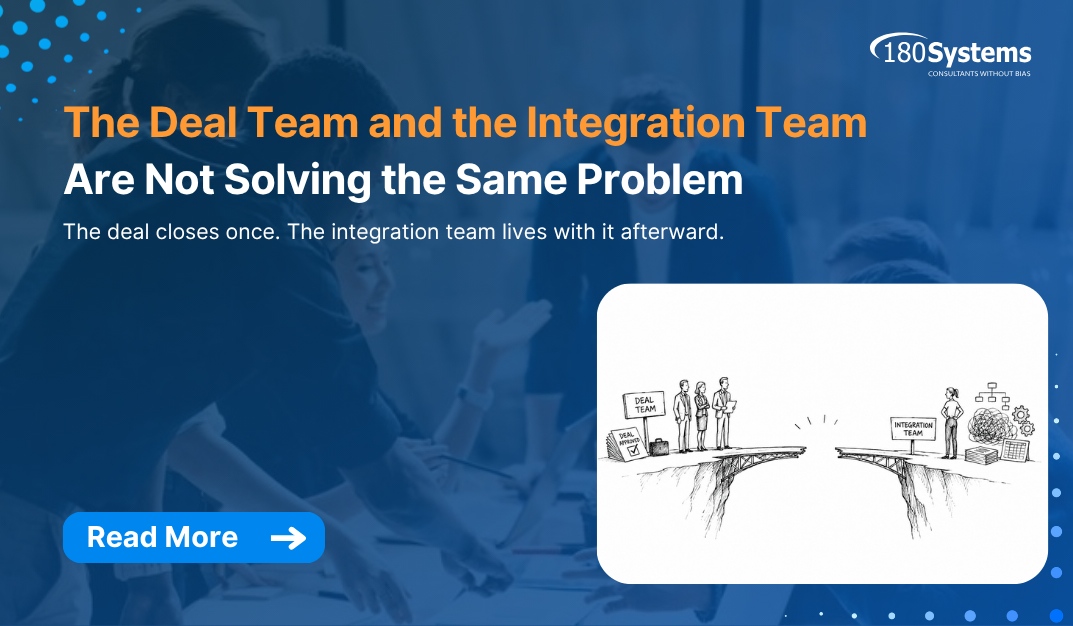
Do you know what’s interesting? In M&A the deal team and the integration team are often running toward completely different definitions of success. None of these groups are smarter than the other, and not because they are intentionally creating problems, but because they are sitting inside completely different realities.
The deal team is trying to get the transaction across the finish line. The integration team is trying to figure out whether the organization can actually absorb what is being purchased without creating operational chaos six months later. Both sides are intelligent. both sides are protecting value in their own way. But they are operating under completely different pressures, and that difference quietly shapes the entire trajectory of the acquisition.
Deal Team vs Integration Team Before Close
Before close, the energy in the room is usually optimistic. The strategic fit makes sense, the valuation has been debated, and the synergy story is compelling enough to survive several steering committee meetings, also at least one slide with suspiciously smooth hockey-stick growth. Advisors are aligned perfectly and leadership is emotionally invested. Nobody wants to slow the process down by introducing friction unless the issue is severe enough to threaten the deal itself.
The integration team sees the same environment very differently. While everyone else is talking about growth opportunities and future-state operating models, they are trying to understand who will actually own the work once the transaction closes. They are looking at duplicated processes, overlapping leadership structures, disconnected systems, inconsistent data definitions, incompatible reporting structures, and operational dependencies that somehow only become visible after the PowerPoint presentation ends. This is usually where the disconnect begins.
Deal Team vs Integration Team After Close
A “manageable issue” during diligence becomes an operational problem after close. A “temporary workaround” becomes a permanent reporting process involving three spreadsheets, two manual reconciliations, and one exhausted finance manager who now understands the ERP better than the implementation partner. A leadership overlap that felt politically inconvenient to address before close suddenly becomes a decision bottleneck that slows half the organization.
Nobody intentionally creates this outcome. That is what makes it so common.
The deal team is not careless. In many cases, they are making rational decisions inside a process designed around momentum. When a transaction starts moving, every unresolved issue has to battle against timeline pressure, valuation sensitivity, financing windows, executive enthusiasm, and the very human desire to avoid being the person who introduces uncertainty into a deal everyone already wants to happen. So, issues do not disappear; they soften.
A governance concern becomes a future organizational discussion. A systems issue becomes a Day 1 workstream. A process incompatibility becomes “something the integration team can handle after close.” The language changes just enough to move the transaction forward without fully confronting what the organization is agreeing to carry. Then the deal closes and the integration team inherits the operational reality behind all of those softened decisions.
This is one of the reasons integration leaders often sound frustrated before the real work even begins. They are not simply managing change. They are operationalizing assumptions that were developed under a completely different set of motivations. By the time they are given meaningful authority to influence the environment, many of the structural conditions have already been locked into place. And, that is not really an execution issue; it is a governance issue disguised as execution pressure.

The irony is that most organizations already know what good integration requires: They know leadership clarity matters, they know governance matters, they know technology alignment matters, they know that unresolved operational complexity does not magically stabilize because the acquisition announcement used the words “strategic” and “synergistic” twelve times. The problem is rarely awareness.
The problem is that integration concerns become most visible at the exact moment the organization becomes least willing to absorb friction. Once the emotional and financial promise to the transaction builds, operational realism starts competing against momentum. Even thoughtful questions can begin to feel disruptive because they threaten the pace of the deal itself.
How Mature Acquirers Bring Integration Thinking Into the Deal
This is where experienced acquirers separate themselves from inexperienced ones. Mature organizations do not treat integration as a downstream activity that begins after signing. They bring integration thinking into the deal process early enough to influence the structure of the transaction itself. They construct governance environments where operational concerns can surface honestly prior to becoming expensive. Most importantly, they force specific conversations around what risks are being accepted, why they are being accepted, and what the organization will need to recognize afterward.
Because there is a significant difference between knowingly carrying risk and quietly inheriting it, the organizations that integrate well are not necessarily the organizations that avoid complexity. They are the organizations that confront complexity early enough to decide whether they are genuinely prepared to carry it. And that is the part many companies still misunderstand about integration.
The integration team is not there to protect deal momentum. It is there to protect realizable value after the momentum is gone.