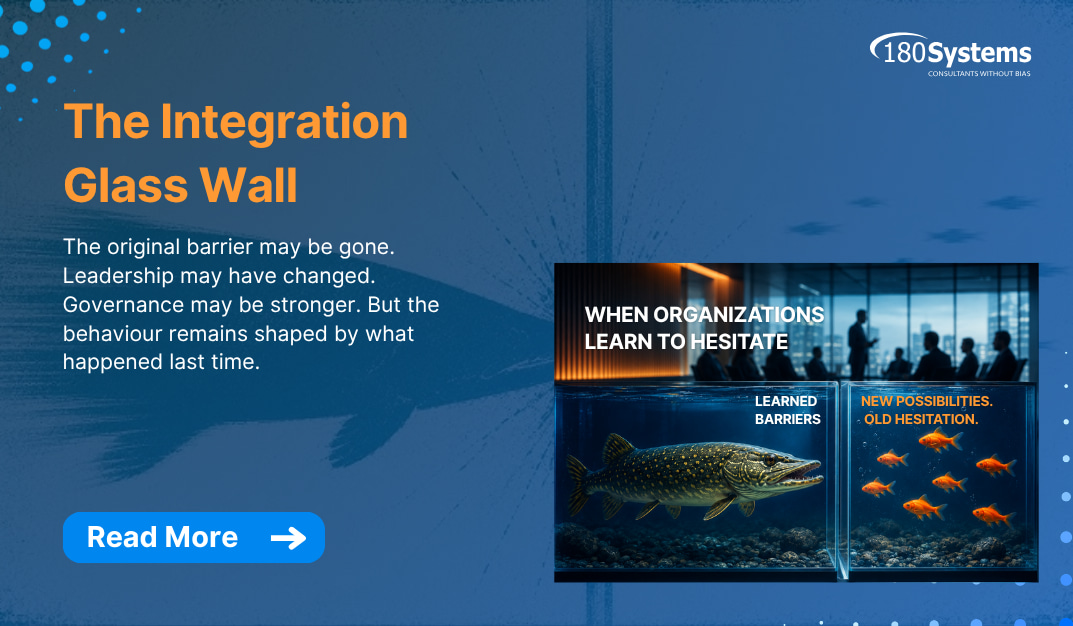
I watched a video about the Pike Effect recently, and because apparently my brain now turns everything into an M&A lesson, I could not stop thinking about integration.
In the video, a pike was placed in a tank with smaller fish, separated by a clear glass barrier. The pike did what pikes do. It went after the fish, hit the glass, got nowhere, and tried again. Eventually, after enough failed attempts and enough bruised ambition, it stopped trying. Then the glass was removed. The smaller fish swam freely around the tank, but the pike still would not go after them. It had learned the barrier was there, even when it no longer existed. That felt uncomfortably familiar.
Organizations do this too. After enough painful integrations, failed ERP implementations, leadership reversals, and transformation programs that promised “this time will be different” before becoming exactly the same, companies learn hesitation. Not loudly. Not officially. Nobody puts “organizational trauma response” on a steering committee slide, although honestly, it might explain a few meetings.
You can usually hear it before you see it. Someone suggests standardizing a process, and the room gets quiet. A systems consolidation discussion starts, and people suddenly become very interested in their notebooks. Leadership announces a new operating model, and everyone smiles politely while mentally calculating how long they need to wait before this initiative disappears like the last one. On the surface, it looks like resistance to change. Sometimes it is. But often, it is memory.
That is the part organizations underestimate. Failed integrations do not just damage timelines, budgets, and synergy capture. They condition people. Teams remember the system implementation that doubled everyone’s workload. They remember the acquisition where nothing stabilized. They remember being asked to support integration while still doing their full-time job, plus three other jobs nobody admitted existed. Eventually, the organization adapts to protect itself.People stop escalating because escalation used to go nowhere. Functions stop collaborating because collaboration used to mean taking on someone else’s mess. Managers stop committing too early because enthusiasm has previously been rewarded with unpaid overtime and a fresh PowerPoint template.
The original barrier may be gone. Leadership may have changed. Governance may be stronger. The organization may genuinely be better prepared this time. But the behaviour remains shaped by what happened last time.
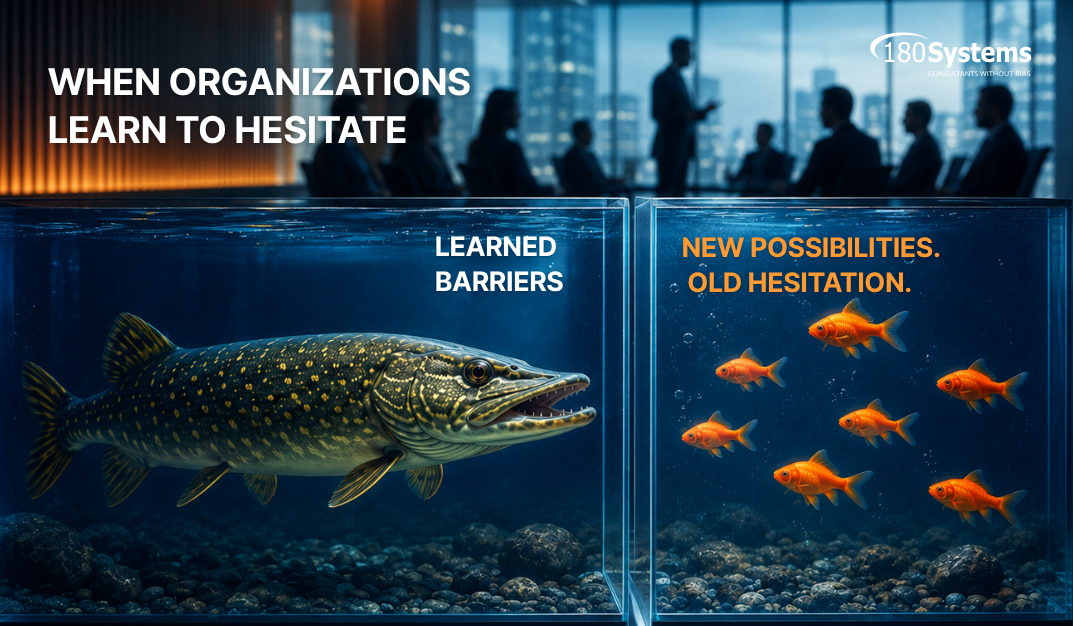
That is why integration capability is harder to build than most organizations think. Capability is not just a playbook, a governance chart, or a beautifully colour-coded plan that gives everyone a false sense of control. It is also organizational confidence. The belief that movement is safe. That decisions will hold. That escalation will matter. That collaboration will not become punishment by another name.
Without that confidence, even a well-designed integration effort can stall. Not because people are lazy. Not because they do not understand the plan. But because they have learned that moving forward is risky.
This is where leadership often misdiagnoses the problem. They assume the organization is resisting the future, when the organization is actually reacting to the past. That distinction matters, because you cannot pressure people out of learned hesitation. More urgency does not remove the glass wall. It usually just convinces people to stop trying faster.
If hesitation was learned, then confidence has to be relearned. Governance has to hold. Decisions have to stay consistent. Escalations have to lead somewhere. Teams need proof that this time, movement will not hurt them. The danger in failed integrations is not only the failed outcome. It is the organizational memory left behind afterward.
And sometimes, long after the glass has been removed, the company is still behaving like it is trapped behind it.