News & views

180Systems_ We Know How to Integrate Companies. So Why Are We Still So Bad at It

We Know How to Integrate Companies. So Why Are We Still So Bad at It?

I’ve been living in two worlds lately. The first is research. Clean, structured, logical. It tells me exactly what organizations should be doing in integration. The second is operators. People who’ve done 30, 50, 150+ deals. Here’s the interesting part: They agree. Start integration early they say, align leadership, build the playbooks and don’t forget to capture lessons learned. Make sure to treat integration like a capability. So naturally, you’d expect consistent success, but no. Most integrations still underdeliver. Not dramatically, just quietly. Missed synergies, slow execution, talent walking out the door. So, what’s going on? We start too late… […]

Read More…

180System_Spring Cleaning Your ERPCRM Implementation Declutter, Optimize, Thrive

Spring Cleaning Your ERP/CRM Implementation: Declutter, Optimize, Thrive

Spring is in the air. Windows open, playlists on, and suddenly you’re questioning why you own three versions of the same thing. It’s the season of fresh starts, and oddly enough, your ERP/CRM implementation could use one too. If you’ve ever managed a system rollout, you know this truth: over time, even the best-planned implementations collect “stuff.” Extra fields. Duplicate workflows. Reports no one opens but everyone is afraid to delete. Before long, your shiny system starts feeling like that mysterious junk drawer in the kitchen. So, let’s grab our metaphorical rubber gloves and do some spring cleaning, project manager […]

Read More…

ERP implementation issues

Why ERP Projects Fail Before They Start

ERP implementation issues are often caused by gaps in project planning before the project begins. No Defined Core Team A common issue is starting your implementation without a clearly defined core team. If there is no internal project manager and roles and responsibilities are not assigned, the team members responsible for delivering a successful project will be confused and frustrated early. Tasks and follow-ups will be missed and the project will be delayed with potential budget over-runs. Define your core team early! Unclear Project Expectations The level of effort required for project success from your internal team is often underestimated […]

Read More…

180 Systems Can You Have Too Many Requirements

Can You Have Too Many Requirements When Selecting an ERP System?

YES! It seems like some consulting companies are getting paid based on the number of requirements in their RFP. And companies doing it without consultants can access templates with thousands of requirements and think it better to include them than risk problems later. If requirements are gathered from a review of business processes, it’s easy to get bogged down in too much detail about basic requirements that any decent system will include these days. Another trap is to include requirements for each business process when a generic requirement (like attaching documents to any transaction or master file) will suffice. Our […]

Read More…

M&A Technology Due Diligence

Why Does Every Integration Feel Like the First One?

I’ve been living in two worlds lately. The first is research. Clean, structured, logical. It tells me exactly what organizations should be doing in integration. The second is operators. People who’ve done 30, 50, 150+ deals. Here’s the interesting part: They agree. Start integration early they say, align leadership, build the playbooks and don’t forget to capture lessons learned. Make sure to treat integration like a capability. So naturally, you’d expect consistent success, but no. Most integrations still underdeliver. Not dramatically, just quietly. Missed synergies, slow execution, talent walking out the door. So, what’s going on? We start too late… […]

Read More…

M&A integration failure_ Most Deals Don’t Fail. They Decay

Most Deals Don’t Fail. They Decay.

Everyone loves to quote the stat. Depending on the source, somewhere between 50% and 90% of acquisitions fail. It’s a wide range, which usually means we’re measuring different things, but the direction is consistent enough to be uncomfortable. Roughly half of acquisitions destroy value for the acquirer, and only about 30% to 50% fully deliver the synergies that justified the deal in the first place. None of this is new. We’ve known it for decades. What I find more interesting is not the statistic itself, but the fact that it hasn’t changed despite how much smarter we’ve become at everything […]

Read More…

M&A Technology Due Diligence_Pre-close Influence vs Post-close Accountability

Pre-close Influence vs Post-close Accountability

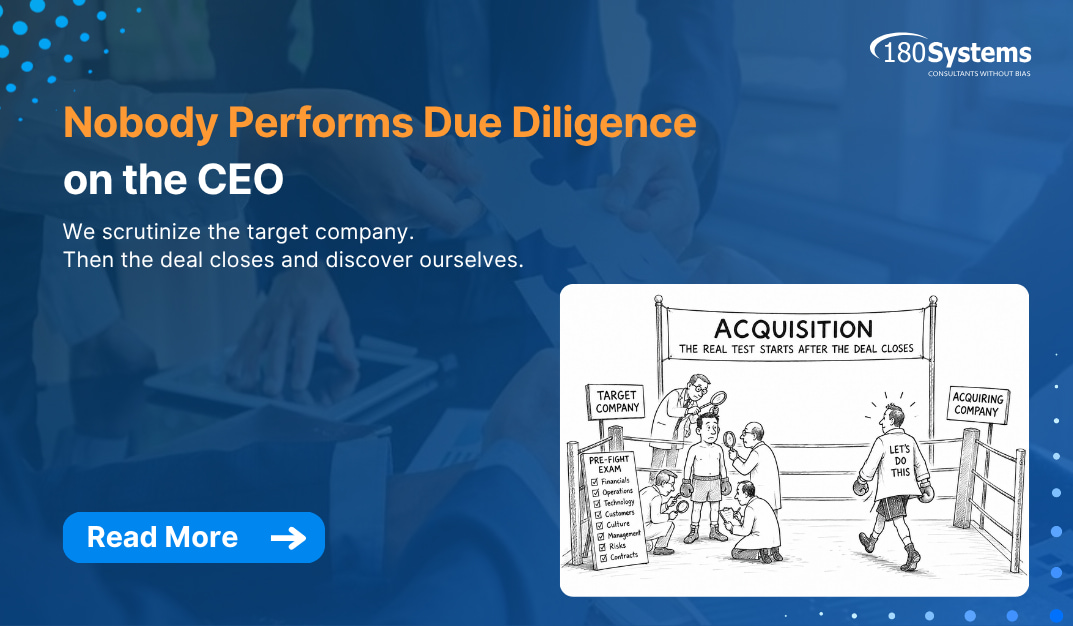
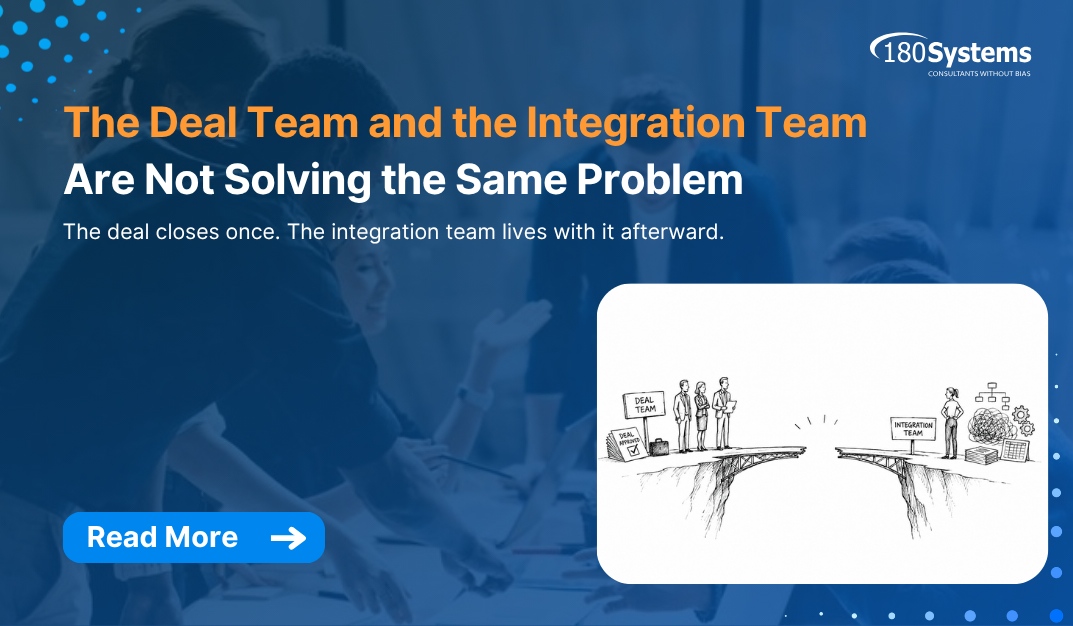
There’s a quiet structural flaw in how most M&A deals are done. It doesn’t show up in the model; it doesn’t sit in the risk register; and yet it’s one of the most reliable ways to lose value. The people who shape the deal are not the ones responsible for delivering it. By the time the operators arrive, the assumptions are already locked in, the commitments are already made, and the clock has already started. Take Cadbury. The narrative most people remember is emotional: a beloved brand, a hostile bidder, a defence mounted with conviction. The reality is far more […]

Read More…

Letting Go (2)

Letting Go

Are you ready to let go of decision making and allow AI to make decision for you whether it’s placing a PO or scheduling service for equipment. That’s what’s coming if you listen to the hype. There are a lot of control freaks that would never let go – and I understand that. But what if you’re open to change and just looking for efficiency and cost savings? Let’s consider purchasing and ask whether AI can improve it. As you may know, MRP (Material Requirements Planning) has been the workhorse for suggesting what to buy for 50 years. It suggests […]

Read More…

180 Systems_Design, by Design. How PLM Modernizes Apparel Development

Design, by Design. How PLM Modernizes Apparel Development

Design is the backbone of every apparel company, but the sheer volume and pace of modern fashion make the design process more complex than ever. Working on multiple seasonal drops, replenishment programs and retail-driven assortments means that apparel companies can manage hundreds or thousands of new designs each year.  Before a single style reaches production, it passes through design, merchandising, planning, product development, sourcing, and finance. Each team contributes sketches, BOMs, measurements, costing, vendor quotes and sample reviews. The amount of coordination and cross-functional collaboration can be monumental, which is why many have found implementing a Product Lifecycle Management (PLM) […]

Read More…

When Technology Due Diligence Doesn’t Move the Needle (1)

When Tech Due Diligence Doesn’t Move the Needle

Most Technology Due Diligence reports are thorough. Painfully thorough. They catalogue systems, they map infrastructure, they inventory applications with the enthusiasm of someone counting grains of sand on a beach. And yet, after all that work, many of them do not actually change the deal decision. So, I ran a poll in the Forbes Leadership Think Tank community asking a simple question: Where does Tech Due Diligence most often fall short? Results were interesting… None of these surprised me, what surprised me was how evenly they reinforce the same underlying problem. Technology Due Diligence often answers the wrong question because […]

Read More…